
 For Boys
 For Girls
 For Kids
 Top Games
 My Games
 Top Games
 My Games


Learn To Fly 3 Game Online
Description
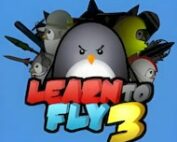
What actually happens when a penguin with no wings decides flight is non-negotiable? That’s the entire premise Learn To Fly 3 runs with, and the game is far less interested in explaining the joke than it is in handing you a launch ramp and a currency system and letting you figure out the rest.
| Genre | Physics-based launch and upgrade game |
| Core mechanic | Launching a penguin off a ramp, then boosting distance mid-flight and upgrading gear between runs |
| Currencies | Coins (per-run) and Science Points (long-term unlocks) |
| Progression | Multiple biomes, unlockable characters, and achievement-based rewards |
The Ramp Launch and Why It Sets Your Whole Run
Every attempt in Learn To Fly 3 begins on the same short ramp, and the timing of your jump off it matters more than most new players assume. Launch too early and you lose height before your glider or rocket boosters even get a chance to matter. Launch too late and you’ve wasted ramp speed you can’t get back.
This single decision point is why the game rewards repetition over raw luck. Players who treat the ramp as a formality tend to plateau early, while players who treat it as its own skill — timing the jump against ramp curvature rather than just holding forward — see distance gains before they’ve bought a single upgrade.
Once you’re airborne, boost management takes over, and that’s a completely separate skill from the launch itself.
Boost Timing Mid-Flight
Boost isn’t unlimited, and burning it all in one long burst near the start of a flight is the single most common beginner mistake in Learn To Fly 3. Short, staged bursts — especially timed to coincide with a dip in altitude rather than a peak — extend a flight far more efficiently than one long thruster hold.
Wing gliders change this calculation entirely once unlocked, since they let you convert altitude into forward distance passively, meaning your boost is better saved for flat stretches where gliding alone won’t carry you.
By the time you’ve unlocked a mid-tier rocket, flights start requiring genuine sequencing: launch timing, an early boost to clear the first altitude drop, a glide phase, then a final boost dump right before landing to squeeze out extra distance.
The Upgrade Shop and What to Prioritize
Coins earned per flight feed directly into upgrades — better wings, stronger boosters, improved ramps — and it’s tempting to spread coins evenly across every category. That approach is slower than committing to one system at a time, because most upgrade trees have thresholds where a single completed tier unlocks a meaningfully different flight behavior rather than a small stat bump.
Score-focused players tend to rush booster upgrades first, chasing raw distance numbers early. Completionist players often prioritize the achievement-linked unlocks instead, since several characters and cosmetic rewards are locked behind specific in-flight actions rather than distance milestones alone.
Either approach works. What doesn’t work is buying whichever upgrade is cheapest each run just to “spend” coins, since that habit stretches out the early game without meaningfully improving your flight distance.
Science Points and Long-Term Unlocks
Separate from per-run coins, Science Points accumulate more slowly and unlock permanent characters and gear categories rather than incremental stat boosts. Early on it’s easy to ignore this currency since the payoff isn’t immediate, but by the time you reach the mid-game biomes, Science Point unlocks start outperforming anything coins alone can buy.
This is one of the more debated aspects of Learn To Fly 3 in player communities — some feel the dual-currency system paces progression well, while others find the slow trickle of Science Points frustrating compared to how quickly coins pile up.
Named Biomes and How Terrain Changes Strategy
Once you push past the starting area, later biomes introduce terrain that isn’t just decorative — wind patterns, elevation changes, and obstacle placement all shift how a boost-and-glide sequence should be timed. A strategy that maximized distance in the first area can underperform badly once wind resistance becomes a factor.
This is where achievement hunters split from distance chasers most visibly, since some of the trickier achievements are tied to specific in-flight actions within these later biomes rather than to total distance traveled.
A community habit worth adopting early: don’t fully commit to one upgrade path before you’ve flown in at least one later biome, since terrain there can make certain builds far less efficient than they looked in the tutorial area.
What Beginners Consistently Misjudge
- Holding boost too early instead of staging it across the flight
- Ignoring Science Points because the payoff isn’t immediate
- Spreading coins across every upgrade category instead of committing to one
- Assuming ramp timing doesn’t matter once boosters are unlocked
Frequently Asked Questions
Why does my distance drop suddenly even with a full boost bar?
Boost applies forward thrust, but altitude still decays under gravity, so holding boost while already descending late in a flight burns your bar without meaningfully extending distance — timing bursts on flatter or rising sections works better.
Should I unlock new characters or upgrade my current gear first?
New characters in Learn To Fly 3 often carry different base stats rather than strict upgrades, so it’s usually more efficient to max out core booster and wing upgrades before spending Science Points on a character switch.
Why do achievements sometimes not trigger even after I complete the action?
Several achievements require the qualifying action to happen within a specific biome or flight phase rather than anywhere in the game, so an action performed in the wrong stage won’t register even if it looks identical to the achievement’s description.
Learn To Fly 3 never pretends its penguin is going to fly gracefully, and that’s the charm — every ramp launch, every staged boost burst, and every Science Point spent on a new glider is just another attempt to make an obviously flightless bird go a little bit further than the last run.

 4
4
 For Boys
  For Girls




























 2681
2681


