
 For Boys
 For Girls
 For Kids
 Top Games
 My Games
 Top Games
 My Games


MOXIE // Graffiti Burst Game Online
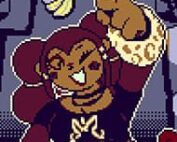
Description
You drop off a rooftop ledge, catch a rail before your speed dies, and tag the wall mid-slide before your wheels even touch pavement again. That loop — skate, grind, tag, repeat — is the whole pulse of MOXIE // Graffiti Burst, a flow-driven skate-and-tag game built around a Game Boy Color look and feel. You play Veve, a rebellious deer chasing a spot in an illegal skateboarding tournament, and from the first rail the game makes it obvious that style counts for as much as survival.
| Genre | Platformer / skate-and-tag |
| Platforms | Browser (HTML5), Game Boy Color, 3DS (CIA), Analogue Pocket |
| Developer | PlatinaXO |
| Average Rating | 4.7 out of 5 (6 ratings) |
| Average Session | About an hour |
Veve, Her Crew, and the Rise of MOXIE
Veve isn’t skating alone for long. As she works her way up the underground scene of the Mischievous South, she pulls together her own crew — MOXIE — a group of colourful misfits who each have their own reasons for backing her run at the title. The game leans into this found-family structure early, using crew banter between runs to explain why Veve keeps pushing forward even as the risks climb.
Standing in her way is DAZE, the rival crew currently ruling the underground, and the rivalry gives every level a reason beyond just the scoreboard. Players who care about narrative pacing in short games tend to notice how MOXIE // Graffiti Burst uses level intros and crew dialogue to keep the DAZE rivalry present without slowing the actual skating down.
Speedrunning-minded players skate past most of this on repeat attempts, but it’s worth slowing down for at least once, since the crew writing is where most of the game’s personality lives outside the rails themselves.
Grinding, Tagging, and Reading a Line
The core loop asks you to read a route before you commit to it. Jump is bound to Z or J, tagging big spots uses X or K, and pulling tricks while grinding means holding the up direction alongside a trick button — timing all three well is what separates a clean run from a wipeout. Dropping through certain platforms with the down key opens shortcuts that aren’t obvious on a first pass.
Early levels teach the grind-to-tag transition in isolation before combining them, which is where most beginners get caught out: tagging too late kills your momentum, and tagging too early means you miss the spot entirely. Once combos start chaining across multiple rails in a single run, the game stops feeling like a tutorial and starts feeling like the tournament it’s building toward.
Players who grew up on Game Boy platformers will recognize the deliberate 8-bit constraints — Aseprite pixel work and a tight colour palette that more than one commenter has called out as the game’s most distinctive visual choice.
It rewards precision over speed at first.
Rank Progression from C to S in MOXIE // Graffiti Burst
Every level scores your run on a letter grade, starting at C-Rank and climbing toward S-Rank as you tighten your combos and clear routes cleaner. Chasing S-Rank on every stage is the game’s real replay hook, since the short, tightly designed levels are built to be re-run rather than played once and abandoned.
Difficulty in MOXIE // Graffiti Burst climbs less through enemy count and more through route complexity — later stages demand you chain grinds across gaps that punish hesitation. By the time you’re consistently landing S-Rank runs, you’re reading each level’s layout almost from memory, which is exactly the kind of mastery loop skating games tend to reward.
Some players have pointed out that the full game’s runtime is on the shorter side, and that’s a fair criticism if you’re expecting a lengthy campaign — the design clearly prioritizes replay value over raw length.
Peckington, Gina, and the Hound Killer Threat
The tournament plot escalates once the city’s president, Peckington — a hare who starts out merely irritated and ends up unraveling — decides Veve has outrun the law one too many times. His response is sending in Gina, known in-game as the Hound Killer, armed with a rifle and a helicopter that turns later levels into genuine chase sequences rather than straightforward time trials.
Gina’s presence changes how you approach a run: routes that were purely about style now have a survival layer stacked on top, and players who favor cautious, methodical play will feel that shift immediately once she shows up.
Story-focused players tend to replay the Gina levels specifically to see how close Veve can cut it, while score-chasers mostly treat her as one more obstacle between them and S-Rank.
How do you earn S-Rank in MOXIE // Graffiti Burst?
S-Rank comes from chaining grinds and tags into unbroken combos rather than clearing a level slowly and safely — dropping through platforms to skip dead space and pulling tricks mid-grind both add to the score that pushes a run from C-Rank up toward S.
Can MOXIE // Graffiti Burst be played on real Game Boy Color hardware?
Yes — alongside the browser-playable demo, the full release ships with .gbc, .cia, and Analogue Pocket files, so owners of original Game Boy Color hardware, 3DS flashcarts, or a Pocket can run it outside the browser entirely.
Is there a way to try MOXIE // Graffiti Burst before buying the full release?
A playable demo runs directly in the browser, covering the early skating and tagging mechanics before Peckington and Gina enter the story, which gives a solid sense of the controls before committing to the full purchase.
Veve’s climb through the Mischievous South is short by design, but MOXIE // Graffiti Burst earns its replays by making every rail, tag, and Gina encounter worth running back for a cleaner S-Rank.

 14
14
 For Boys
  For Girls
























 2684
2684


