
 For Boys
 For Girls
 For Kids
 Top Games
 My Games
 Top Games
 My Games


Dear Passengers Game Online
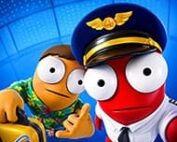
Description
Somewhere between takeoff and whatever counts as a controlled landing, Dear Passengers makes one thing obvious: this airline was never built to survive a single flight, let alone a full route. Everyone on the crew knows it. Nobody says it out loud, because saying it out loud would mean admitting the plane is held together by improvisation and nothing else.
| Genre | Physics-based co-op action |
| Setting | Aboard a failing commercial aircraft |
| Mode | Single-player and online co-op |
Every Job on the Plane Interrupts Another
Dear Passengers splits its players across the jobs that keep a flight technically running. One person takes the pilot seat and is responsible for actually flying the aircraft while everything around them physically deteriorates. Everyone else scatters across cabin duties: managing passengers, handling food service, dealing with cargo, and reacting to weather that seems personally offended by your flight path. None of these jobs exist in isolation, and the game is built almost entirely around that overlap.
The comedy engine here comes from timing, not scripted jokes. A cargo problem doesn’t wait politely for food service to finish. A passenger meltdown doesn’t pause because the pilot needs a hand in the cockpit. Everything happens on top of everything else, and the crew has to triage in real time, usually while shouting conflicting instructions at each other.
Early in a flight, most of these interruptions are manageable one at a time. By the time you’re deep into a route, three or four problems are usually stacking simultaneously, and that compression is where Dear Passengers earns its reputation as a game that gets harder through sheer accumulation rather than any single difficulty spike.
The Cargo Hold’s Real Priorities
The cargo hold is where Dear Passengers gets its sharpest edge. Your plane isn’t just carrying luggage, it’s carrying cargo the airline clearly isn’t supposed to have onboard, and managing it becomes its own mini-crisis layered on top of everything else. Passenger safety, meanwhile, is treated as a checkbox rather than a priority, which sets up most of the game’s chaos: the crew is constantly choosing between doing things properly and doing things fast enough that the flight survives the next few minutes.
Players who gravitate toward the cargo hold tend to become the group’s risk managers, deciding what gets secured first and what gets left to chance when time runs short. It’s rarely a glamorous role, but a cargo hold left unattended for too long has a way of turning into the flight’s biggest problem without anyone noticing until it’s already too late.
Weather as an Active Opponent
Weather in Dear Passengers doesn’t sit quietly in the background. It actively interferes with whatever job you’re mid-task on, whether that’s food service, calming a cabin full of passengers, or trying to secure cargo that’s already sliding across the hold. New players tend to underestimate how much weather events compound with everything else happening — a single storm can turn three manageable jobs into one overlapping mess that nobody can fully solve alone.
Passengers themselves aren’t a static backdrop either. They react to how the flight is going, and a cabin that feels unsafe becomes a second problem stacked on top of the mechanical one. Balancing reassurance with actually fixing the plane is a constant tug of war, and it’s usually the moment where coordination between players either holds together or completely falls apart.
Some crews develop an informal rule of thumb once weather hits: someone stays glued to passengers no matter what else is breaking, because a cabin that spirals into panic makes every other job harder to finish. Whether that’s the right call is one of the more common debates among players comparing notes after a rough flight.
Playing Solo Versus a Full Crew
Dear Passengers supports both single-player and full crew sessions, and the experience shifts dramatically depending on which one you’re in. Alone, you’re juggling every role yourself, sprinting between the cockpit and the cabin as problems stack up faster than one person can reasonably handle. Solo runs reward efficient routing between tasks more than raw multitasking skill, since you physically cannot be in two places at once.
With a full crew, the chaos becomes more physical and more social — someone is always yelling about cargo while someone else is mid-conversation with a passenger who picked the worst possible moment to have a meltdown. Communication becomes the actual bottleneck in a full crew run, not the individual tasks themselves. A crew that talks over each other loses more time to confusion than to any single mechanical failure on the plane.
Can you play Dear Passengers alone?
Yes, the game supports single-player, though you’ll be responsible for piloting, cargo, and passengers simultaneously, which is considerably harder than splitting those duties across a crew.
What makes the illegal cargo dangerous during a flight?
It adds an extra layer of risk on top of normal cargo handling, since crew members have to manage it carefully while still keeping the rest of the plane from falling apart around them.
Does weather actually affect gameplay or is it cosmetic?
Weather directly interferes with tasks in progress, meaning a storm can interrupt food service, cargo handling, or passenger management all at once, forcing the crew to prioritize on the fly.
Dear Passengers works because it never lets any single job feel isolated — the pilot’s problems become the cabin’s problems within seconds, and the cargo hold’s secrets have a way of surfacing at the worst possible altitude. Few games make “everything is fine” feel like such an obvious lie in real time.

 10
10
 For Boys
  For Girls




























 2689
2689


