
 For Boys
 For Girls
 For Kids
 Top Games
 My Games
 Top Games
 My Games


La Madriguera Game Online
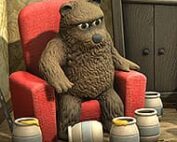
Description
You drag the reading lamp two inches to the left and watch the whole shelf tip, sending a paperback sliding down into the cushions where the cake is sitting. That’s a normal five seconds in La Madriguera, a game built entirely around one lazy bear, one armchair, and one slice of chocolate cake that refuses to come any closer on its own.
| Genre | Physics puzzle |
| Setting | A cluttered burrow with a single armchair |
| Main Goal | Get the cake into the bear’s paw without moving him |
| Controls | Mouse drag to manipulate objects, R key to restart |
Inside La Madriguera’s One-Room Puzzle
The premise sounds almost too simple to be a real game: a brown bear is slumped in his armchair, a piece of cake sits a few feet away on a low table, and getting up is not on the table, so to speak. Instead of walking the bear anywhere, you control his single outstretched paw with the mouse, grabbing whatever furniture, cushions, or knick-knacks happen to be scattered around the burrow. The den itself is small and stuffed with clutter — a rug, a lamp, a stack of books, a couple of chairs — and every one of those objects can be pulled, pushed, tipped, or dropped depending on how it’s positioned. Because the whole layout has to be rearranged with one paw and basic physics, a lot of your early attempts end with the cake rolling somewhere worse than where it started, which is honestly half the appeal.
What makes the loop hold up over repeated tries is that nothing behaves on rails. Knock a chair leg wrong and it doesn’t just fall in a scripted animation, it tumbles the way a real object with that much weight actually would, sometimes clipping the table and knocking the cake off entirely.
The Bear, the Paw, and the Rules of Staying Seated
The bear himself is the whole joke and the whole constraint at once. He stays anchored to the armchair for the entire level, and no amount of clever dragging will ever coax him upright — the game is explicit that standing is off the table, which forces every solution to come from the environment instead of the character. That’s a deliberate inversion of how most puzzle games work: you’re not solving a maze with a moving hero, you’re solving a static hero’s problem by rearranging the maze around him. Players who go in expecting to eventually walk the bear somewhere tend to get stuck fastest, because they keep looking for a path instead of a mechanism.
The single paw is your only tool, and it can grab almost anything within reach, including objects that seem purely decorative at first glance.
Once you accept that the paw is doing all the work, the room stops looking like scenery and starts looking like a toolbox, which is the exact moment the game clicks for most people.
Why the Fork Changes Everything in La Madriguera
Partway through experimenting, most players discover that an ordinary fork sitting near the armchair can be stretched out far beyond its normal length, turning it into a makeshift lever or hook. This single object does more to reshape the puzzle than anything else in the den, because it lets the bear’s paw reach across gaps that look impossible at first glance. Early in the game, before you’ve noticed the fork’s real potential, the temptation is to brute-force a solution by yanking the table itself, which usually just topples everything into a pile that’s harder to work with than before.
Community discussion around the game keeps circling back to this fork moment specifically, since it’s the point where the puzzle stops feeling like a physics toy and starts feeling like an actual logic problem with a real answer.
Objects That Look Useless Until They Aren’t
Part of what keeps people replaying is realizing how many background props actually matter. A cushion isn’t just padding, it’s a ramp. A stack of books isn’t clutter, it’s a counterweight. This design choice rewards the kind of player who pokes at everything rather than beelining for the obvious target, and it’s a big part of what forums mean when they call the game’s environment “load-bearing” in a way most puzzle titles never bother with.
- The rug can be tugged to shift anything resting on top of it
- The lamp’s cord acts as an improvised pulley when pulled at the right angle
- Loose cushions absorb falls that would otherwise send the cake flying off the table
None of these interactions are labeled or highlighted, so the game is quietly asking you to test things rather than telling you what matters, which some players find satisfying and others find a little too opaque for a game this short.
Questions Players Ask About the Cake and the Paw
How do you actually beat La Madriguera?
You need to use the paw to manipulate the armchair’s surroundings — usually the fork, the nearby table, and at least one prop like the lamp or a cushion — until the cake is nudged, tipped, or launched directly into the bear’s reach without him ever leaving the chair.
Is La Madriguera really only one level?
Yes, the core release is built around a single den and a single objective, which is why most sessions run short; the depth comes from how many different physical solutions exist for that one setup rather than from a long level list.
Why does the cake keep flying off the table?
That usually happens when a heavy object like a chair or the table itself is knocked at the wrong angle, sending momentum through the surface the cake is resting on instead of directly toward the bear’s paw.
For a game with only one room, one bear, and one piece of cake, La Madriguera manages to turn a single fork into the most argued-about object in the whole burrow, and that’s usually enough to keep a first-time player coming back for a second attempt.


 2110
2110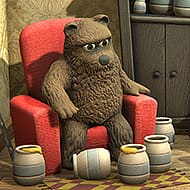
 For Boys
  For Girls














 2697
2697

