
 For Boys
 For Girls
 For Kids
 Top Games
 My Games
 Top Games
 My Games


Ritter & Rotwein Game Online
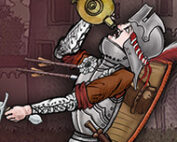
Description
You take a swig of wine mid-duel, your knight’s joints go loose exactly when you need them steady, and the swing you meant to land turns into a stumble that somehow still connects. That’s Ritter & Rotwein in a single moment — healing and losing control are the same action.
| Genre | Physics Action-Adventure |
| Setting | 15th century |
| Modes | Campaign, Local Multiplayer, Remote Play |
| Core Mechanic | Ragdoll physics combat |
The Ragdoll Knight at the Center of Ritter & Rotwein
Every knight in Ritter & Rotwein is a full ragdoll — joints, mass, and momentum governing movement at all times, not just in death animations the way most games use the technique. That means a stumble, a heavy swing, or an off-balance step all carry real physical consequences instead of being cosmetic flourishes layered over a fixed animation set.
Players coming in expecting tight, deliberate sword-fighting controls tend to get frustrated early, since precision here isn’t about frame-perfect inputs — it’s about reading momentum and accepting that your knight will occasionally do something you didn’t quite intend.
Once that shift in expectations clicks, the appeal becomes obvious: it’s less a combat game with physics bolted on and more a physics toy that happens to have swords in it.
Wine as a Healing Item — and a Liability
The central mechanic is right there in the title. Drinking wine heals your knight, but it also temporarily degrades physics stability, meaning your recovery comes at the exact moment you’re least able to control your own movement. It’s a rare case of a healing item being genuinely risky to use rather than a free safety net.
- Take damage during combat or a fall
- Decide whether the fight allows a moment to drink
- Drink wine to heal, accepting reduced stability
- Compensate for the wobblier movement immediately after
Timing that drink is one of the more debated aspects of the game in early community discussion — some players lean on wine constantly and adapt to the instability, while others avoid it until absolutely necessary, treating stability as more valuable than the healing itself.
Physics Stability and Why Heavier Armor Backfires
Armor weight directly affects how controllable your knight is. Heavier, more protective sets look and sound like the safer choice, but the added mass makes the ragdoll harder to keep upright, especially once wine has already knocked your stability down. Lighter loadouts sacrifice protection for a knight that’s actually easier to steer through a fight.
This creates a genuine build tension rather than a simple stat trade-off, since the “stronger” gear on paper can leave you worse off in practice if you can’t control the character wearing it.
Campaign Levels in Ritter & Rotwein
The single-player campaign has you creating your own knight and pushing through a series of levels that escalate in difficulty as you go, chasing the fame and honor the game frames as the entire point of surviving a course intact. Early levels ease you into ragdoll movement on relatively forgiving terrain before later stages start combining tighter platforming with active combat.
By the time you reach the later campaign levels, the wine-and-stability tension from earlier stops being optional — you’re forced to make real trade-offs between healing and control under actual time pressure.
Local Multiplayer Duels and Remote Play
Alongside the campaign, Ritter & Rotwein supports local multiplayer duels, letting a second knight settle things directly rather than fighting the level design solo. Remote Play support extends that to friends who aren’t physically in the same room, which matters a lot for a game whose chaos is arguably funniest when someone else is watching it happen live.
Weapon and Armor Sets Rooted in the 15th Century
The weapons and armor draw from actual late-medieval equipment — the kind of gear players familiar with historical combat games will recognize, even filtered through the game’s exaggerated ragdoll presentation. That grounding gives the physics comedy something to play against; the chaos reads funnier specifically because the equipment looks like it’s trying to be taken seriously.
Ritter & Rotwein holds together because it never lets you forget that healing and stability are in constant tension — every bottle of wine you drink to save your knight is also the thing most likely to send him tumbling face-first into the next obstacle, and that push and pull is what keeps campaign levels and local duels alike from ever feeling fully predictable.

 37
37





















 2694
2694


