
 For Boys
 For Girls
 For Kids
 Top Games
 My Games
 Top Games
 My Games


Fart Together Game Online
Description
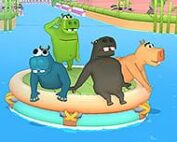
You tap the gas a half-second after your friend does, and the raft that was lining up with the gap swings sideways into a wall. Nobody agrees on who caused it, and everybody is already shouting. That moment is what Fart Together is built around: a physics-based obstacle course where 2–4 players steer one shared raft with fart power, and every input from every player pushes the whole team somewhere new.
| Genre | Physics-based co-op obstacle course |
| Players | 2–4 in co-op, up to 8 in Team Race |
| Main goal | Reach the finish line |
| Early Access content | Roughly 4–5 hours of courses |
Steering One Raft With Direction, Timing and Gas in Fart Together
The first thing to understand about this game is that nobody controls a personal character. The raft is the character, and each player adds direction, timing and gas to it at the same moment. When four people push in four directions, the raft does not average them out politely. It lurches, spins and ends up exactly where nobody planned to go. The premise sounds like a joke, and the humor is real, but the steering underneath is surprisingly strict.
The developers sum up the whole idea in one line: farting harder is not the goal, farting together at the right time is.
Beginners usually learn this the hard way. A new group tends to hammer full gas on a straight stretch, then discovers that speed becomes a liability the moment the course tightens. Party-game fans who like to mash buttons lose the most raft control in the first few minutes, while players with a calmer sense of rhythm tend to become the natural caller of the beat.
Narrow Passages, Sharp Turns and Moving Obstacles
The courses are designed to punish loose coordination. Narrow passages demand that everyone agrees on a line, sharp turns demand that someone slows down while the others hold direction, and hazards that throw the raft off balance turn a clean run into a recovery. Sometimes the team needs to speed up, sometimes slow down, and sometimes everyone has to make the same move at the same instant.
A few situations repeat across the courses and are worth recognizing early:
- Narrow passages reward a slow, agreed line instead of a fast one.
- Sharp turns reward one player cutting gas while the others hold their direction.
- Moving obstacles reward waiting for the gap instead of racing toward it.
Once a moving obstacle swings across the lane, the difference between a coordinated team and a chaotic one becomes obvious. Coordinated teams hold position and let the obstacle pass, while chaotic ones all decide to rush at the same time but in different directions. Completionists who want a clean run on every course will end up replaying the tight passages more than anything else, and patience there adds up over the hours.
Team Race and Bigger Groups in Fart Together
Besides the classic 2–4 player co-op, there is Team Race, where up to 8 players split into two teams and send their rafts through the same obstacle course to see who reaches the finish line first. The shift is bigger than it sounds. Co-op is about surviving the course together, but Team Race adds a second raft you can see and cannot control, and every mistake now costs time against another team instead of just a retry.
That second raft changes the argument, because blame now travels in two directions.
Friend groups who care more about competition than cooperation will find Team Race the natural place to settle old scores, and the expanded selection of playable characters in Early Access gives each player something to pick and joke about. Xbox controller support covers players who prefer a pad, and Steam Deck optimizations make the raft easy to bring to a couch session.
What Divides Players: Blame, Balance and Raft Physics
The physics are the most debated part of the game. The developers openly admit the raft does not simulate real rafts, and that looseness is part of the charm, but it also means a bad bounce can feel unfair. Teams spend as much time arguing about why the raft flew off in a certain direction as they do steering it, and some players enjoy that debate while others find it exhausting.
Early Access also means the difficulty curve, controls and balance for different group sizes are still being tuned. A duo and a full foursome will not necessarily feel the same on identical courses, because fewer players mean fewer inputs to untangle but also fewer hands to correct a mistake. Anyone expecting a fully polished roster of courses should keep that in mind.
For anyone asking how long the game lasts, the current content covers roughly 4–5 hours, and it stretches further for groups that keep saying one more try after every failed passage. Streamers and friend groups who thrive on shouting at each other will get the most mileage, while quieter groups may find the chaos tiring after a few courses.
Fart Together works best when the raft becomes a conversation instead of a contest: someone calls the turn, someone cuts the gas, and the narrow passage finally opens up. Whether you stay with 2–4 player co-op or push into Team Race with a full eight, the real challenge is never the course alone, it is the moment your whole crew has to fart together. Bring the friends with the worst sense of direction, because they will make the best stories.

 4
 3 Player
 4 Player






























 2697


