
 For Boys
 For Girls
 For Kids
 Top Games
 My Games
 Top Games
 My Games


Death Ray Manta Game Online

Description
What happens when a screen packs in mines, robots, and darting rabbits, then gives you less than fifteen seconds to clear all of it before the next one loads? That’s the entire pitch behind Death Ray Manta, and it never really slows down to explain itself beyond that.
| Genre | Twin-stick arcade shooter |
| Protagonist | DEATH RAY MANTA, a fish who fires lasers from his head |
| Levels | 32 screens |
| Level Length | 7 to 15 seconds each |
Thirty-Two Screens, Never More Than Fifteen Seconds Each
Death Ray Manta is built around 32 individual screens, and none of them overstay their welcome. Each one runs somewhere between 7 and 15 seconds before you’re either dead or moving on, which keeps the pace relentless without ever feeling like a slog.
That structure means failure barely costs you anything in time. Dying just drops you back at the start of the same short screen, so a mistake is closer to a shrug than a setback.
Because each screen is so short, the game leans on immediate visual read rather than memorization — you either spot the pattern of mines and robots fast enough to react, or you don’t. Players chasing a personal best on a single screen treat every restart as free practice rather than a loss, since nothing about the short runtime punishes repetition.
A Fish Named Death Ray Manta and the Friends He Can’t Stop Killing
The protagonist isn’t a generic manta ray — he’s literally named DEATH RAY MANTA, and the game’s own premise explains why he ended up alone in space: he blew up his house because of an unfortunate problem with having lasers in his head, and rather than risk destroying anything else, he moved out to live among the stars instead.
His friends still come round to visit, drawn in by Space Tiffin, but because Death Ray Manta can’t control the lasers in his head, he ends up killing them too, over and over, screen after screen, until he’s the only thing left alive in a cold, unwelcoming universe. It’s a dark little joke wrapped around an otherwise weightless arcade premise, and the game never treats it as more serious than that.
Movement and shooting are handled with twin sticks, one for drifting Death Ray Manta around the arena and one for aiming, which is standard for the genre but executed with enough responsiveness that aiming never feels like the bottleneck.
Why Death Ray Manta Never Punishes You With a Lives System
There’s no finite lives counter here. Die, and you’re back at the start of the current screen almost instantly, which keeps the loop feeling more like an arcade cabinet daring you to try again than a game trying to waste your time.
That design choice fits the short screen length perfectly. A harsh lives system would have made the constant colorful chaos feel punishing instead of playful, and the game clearly prioritizes the second feeling. Once you’ve died on the same screen four or five times in a row, the lack of a lives counter is the only reason it still feels fun rather than frustrating.
Space Tiffin: The Gem That’s Actually a Cake
Space Tiffin is the item at the center of Death Ray Manta’s whole premise — it looks like a glowing gem drifting through the arena, but in the game’s own telling it’s actually a generously sized piece of Space Cake, since space apparently has its own culinary rules. It’s what draws Death Ray Manta’s friends in to visit him in the first place, and chasing one down mid-screen means risking a detour past an active mine or an incoming shot from a robot.
Score-focused players tend to treat every piece of Space Tiffin as worth the detour, while players just trying to reach screen 32 in one piece often ignore it entirely in favor of playing it safe.
That tension between grabbing Space Tiffin and just surviving the screen is a small but deliberate piece of design — the reward is never free, and the game counts on you weighing it against whatever else is currently trying to kill you.
Shooting Down Bullets Instead of Dodging Them
One detail that separates Death Ray Manta from a pure dodge-everything shooter is that your own shots can destroy incoming enemy projectiles. That gives the weapon a defensive function alongside its obvious offensive one, letting you survive a screen even when drifting out of the way isn’t an option.
Enemies along the border of the arena fire off their own energy shots regularly, and knowing you can shoot through them rather than only around them changes how aggressively you can play. Once a screen fills with more incoming fire than open space, this defensive habit is usually what separates a clean clear from a cheap death.
Mines, Robots, and Rabbits: Reading a Screen Fast
The enemy roster stays visually chaotic but mechanically readable once you know what to look for:
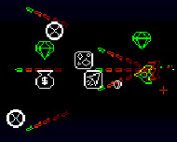
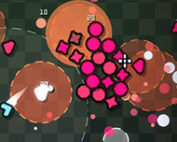
- Mines that sit still but explode on contact, punishing careless drifting more than bad aim
- Robots that patrol and fire back, forcing you to prioritize targets rather than spray in every direction
- Rabbits that dart unpredictably across the screen, breaking up any rhythm you’ve settled into
- Triangular obstacles that kill on touch and can’t be destroyed, acting as permanent hazards you have to route around
Learning to tell these apart at a glance, in the middle of a wall of neon color, is really the core skill the game is testing across all 32 screens.
The Southpaw Option and an Honest Warning About the Flashing
A Southpaw option lets players swap which stick handles movement and which handles aiming, a small accommodation that matters more than it sounds like in a game built entirely around twin-stick reflexes.
It’s worth being direct about one thing, though: Death Ray Manta flashes constantly, and there’s no setting to tone it down. The game itself is upfront that this could be a problem for players with photosensitive epilepsy, and that’s not a minor caveat — it’s a real accessibility limitation baked into the core visual style rather than an occasional effect you can avoid.
Critics have generally been kind to the game’s audiovisual intensity otherwise, often comparing it to the lineage of arcade shooters running from Robotron through Geometry Wars, but that comparison only holds for players who can actually tolerate the nonstop flashing in the first place.
What is Space Tiffin in Death Ray Manta?
Space Tiffin is a gem-like collectible that’s actually described in the game as a piece of Space Cake, drawing Death Ray Manta’s friends in to visit him — friends he then accidentally kills with the same lasers that got him exiled to space in the first place.
Does Death Ray Manta have a lives system?
No. Dying simply restarts the current screen almost instantly, so there’s no finite lives counter limiting how many attempts you get.
Is Death Ray Manta safe to play if I’m sensitive to flashing lights?
No, and the game says so itself — it flashes constantly throughout, with no option to reduce or disable the effect, so anyone with photosensitive epilepsy should treat that as a genuine reason to skip it.
Death Ray Manta earns its reputation as one of the more purely arcade-flavored shooters out there — 32 screens, no patience for slow starts, and a fish who never stops firing the lasers that got him exiled from his own house in the first place. Chasing down Space Tiffin while dodging mines and rabbits is the whole game distilled into a single, flashing, unapologetically silly premise.

 35
35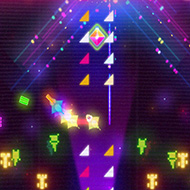
 Arena
Arena 





















 2688
2688


