
 For Boys
 For Girls
 For Kids
 Top Games
 My Games
 Top Games
 My Games


Absurd Trolley Problem Game Online
Description
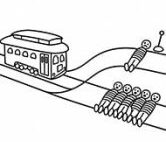
Absurd Trolley Problem looks like a throwaway joke built on a meme, but it plays like a stress test for your own consistency. You get a runaway trolley, a lever, five people tied to one track and a single person on the other, and two options: Pull the lever or Do nothing. Within a few minutes the setup stops being about headcount and starts asking what you are willing to trade away, and the answers you gave three scenarios ago begin to contradict the ones you give now.
The Lever, the Trolley, and Two Choices in Absurd Trolley Problem
Every scenario runs on the same skeleton. A trolley rolls toward a group of people tied to the track, you stand beside the lever, and you pick between Pull the lever and Do nothing. The animation then plays out, so you watch the result happen instead of reading about it. There is no timer to beat and no score to maximize, which makes the whole game feel closer to a quiz about yourself than a puzzle with a solution.
The first scenario is the classic setup: five people on the main track, one on the side track. Most players have met the thought experiment before, so early in the game the decision is quick and almost automatic. That speed is deliberate, because it sets a baseline that the later scenarios keep chipping away at.
Around 30 scenarios follow, and each one changes a single variable: who is tied to the track, what you stand to gain, or what the lever really costs you. A full run fits in one short sitting, and many players start over just to test a different instinct on the same dilemmas.
What New Players Get Wrong About Pulling the Lever
Newcomers treat the lever as the active choice and Do nothing as the neutral one, assuming that staying passive keeps their hands clean. The scenarios exist largely to break that assumption. Once the rich man shows up and offers you $500,000 to pull the lever, you realize the decision is no longer a clean count of bodies, and that your own reasoning has a price tag you did not know about.
Another common mistake is committing to a single rule on the first screen. Someone who decides to always pull the lever to save the larger group tends to hit a scenario where the numbers still favor pulling but the cost suddenly feels personal. Players who enjoy philosophy debates usually discover here that a tidy rule survives only until something they care about is attached to a track.
Rushing is the third trap. Reading the full description before clicking matters, because small wording details change who is actually harmed and who benefits from the lever.
When the Five People Stop Being the Point
The opening scenarios keep the headcount as the main tension. As the game goes on, the stakes drift toward strange trade-offs, and things like savings, your own life, or even a delayed Amazon delivery get weighed against another person. The comedy comes from how seriously the interface treats these trades, with the same calm lever and the same two tracks no matter how silly the reason on the table.
By the time you reach the later scenarios, the people on the tracks are often not the real question. The question becomes what price you quietly put on things, and whether that price holds still from one screen to the next. Completionists who replay the run to see every outcome tend to notice this pattern before anyone else.
Not every scenario lands, and honest players say so. Some of the later setups lean on shock more than on a real dilemma, and a few feel like variations on a joke already told earlier in the run. Even so, the sheer variety is the reason people keep clicking Pull the lever just to see what the next absurd setup looks like.
Reading the Percentage Split After Each Choice in Absurd Trolley Problem
After every decision, the game shows how other players chose, as a split between Pull the lever and Do nothing. That reveal is the real payoff, because it turns a private moral judgment into a comparison with strangers. You can feel the difference between landing with the overwhelming majority and finding yourself alone on the thin side of the bar, and that small jolt is what pushes many players into one more scenario.
Community talk tends to center on these splits rather than on the trolley itself. Players compare which scenario produced the closest thing to a coin flip and which one made them feel like an outlier. Casual players who just want a quick laugh often read the percentages like a scoreboard, even though nothing in the game is keeping score.
A caution is worth stating plainly. The split reflects whoever happened to click, not a controlled study, so it works better as a conversation starter than as evidence about what people would do in real life.
Why Doing Nothing Is Not a Safe Answer
Do nothing looks like the cautious button, but the trolley keeps rolling whether you act or not. Some scenarios are built so that inaction is the harmful path, while others reverse it, and the game never tells you in advance which kind you are facing. Once players notice that, they stop using Do nothing as an escape hatch and start choosing it only on purpose.
A habit that helps is asking which button you would press if the people on the tracks were swapped. If your answer changes, you have found the variable that actually drives your decision, and it is rarely the one you expected when you started the run.
Players who want a deeper run often play twice, once on pure instinct and once while holding to a strict rule, then compare the two sets of choices. The gap between them says more about your thinking than any single scenario does.
Questions Players Ask Before Starting Absurd Trolley Problem
- How many scenarios does a full run include? A complete run covers roughly 30 scenarios, beginning with the classic five-versus-one setup and moving into increasingly odd trade-offs. Each scenario ends with the same two options, Pull the lever or Do nothing, so a run stays short even when you stop to think.
- Can you win or lose? There is no win condition and no failure state, because both Pull the lever and Do nothing always lead to the next scenario. The only measure of how you did is the percentage split that appears after each choice, which shows how your decision compares with everyone else’s.
- Is there a correct answer to the rich man and his $500,000? No, and that is the point of the scenario. The game never grades your choice, so pulling the lever for the money or refusing it both go through the same animation, and the split afterward simply shows what other players decided.
Absurd Trolley Problem works because the lever never changes while the reasons for pulling it keep getting stranger. By the time the rich man’s $500,000 offer has made you question your own rules, the difference between Pull the lever and Do nothing no longer feels like a puzzle you can solve, only a record of what you value.

 1
 Puzzle

































 2710


