
 For Boys
 For Girls
 For Kids
 Top Games
 My Games
 Top Games
 My Games


Tiny Signal Lost Game Online

Description
In Tiny Signal Lost you start inside a failing relay station orbiting a dead communications belt, and the first minutes already force you to treat silence as a system rather than an absence.
| Genre | Atmospheric survival puzzle |
| Core Mechanic | Restoring fragmented signal chains across broken nodes |
| Main Setting | Orbital relay network “ECHO-9 Belt” |
| Primary Tool | Signal Reconstructor Unit (SRU) |
| Key Resource | Frequency Shards |
Signal Reconstruction Flow in Tiny Signal Lost
The Signal Reconstructor Unit defines almost every interaction in Tiny Signal Lost, and its behavior changes the way players interpret space itself. Early reconstructions only require two-node links, but even then the system introduces signal lag that forces delayed confirmation cycles. That delay becomes a learning point rather than a flaw, because it teaches timing discipline before complexity increases.
By mid progression, reconstruction chains stretch across multiple relay segments, sometimes connecting five or six nodes across unstable orbital drift paths. Players begin to use the community term “soft sync routing” to describe carefully staggered connections that avoid collapse cascades. The game quietly rewards patience, and rushing almost always results in signal decay loops that force complete rebuilds.
Once ECHO-9 fringe zones open, reconstruction stops being about completion and becomes about maintenance under pressure. You are not just building networks, you are constantly repairing them while they degrade in real time. Strategy-focused players tend to thrive here, while exploration-focused players often struggle with the constant rebalancing requirement.
A subtle detail players notice is the audio distortion shift when a link is about to fail, a low static pulse that intensifies before collapse. This cue becomes essential in high-density networks where visual tracking is no longer enough. Many players describe it as the moment the game “talks back” through interference.
Environmental Systems and Tiny Signal Lost Structure
The ECHO-9 Belt is not a fixed environment in Tiny Signal Lost, and that instability affects every solved puzzle afterward. Relay nodes drift slowly between cycles, changing connection angles just enough to break previously optimized routes. This forces constant adaptation instead of memorized solutions.
A major system is the Aurora Disruption Field, which intermittently scrambles active signal lines and introduces unpredictable reroute demands. Players often refer to it as the “silent breaker” because it invalidates carefully constructed chains without visible cause. The randomness is not absolute, but its rhythm is subtle enough to feel chaotic during early encounters.
By the time players reach outer belt corridors, environmental overlap begins stacking multiple disruption zones at once. This creates layered interference where one system failure triggers another in a delayed chain reaction. The game intentionally avoids clear separation between cause and effect in these moments.
Not all players enjoy this design philosophy. Some argue that Tiny Signal Lost relies too heavily on instability rather than clear puzzle resolution, while others appreciate the tension of maintaining fragile systems. This split opinion is one of the most consistent debates in the community.
Tools, Upgrades, and Signal Behavior
The Signal Reconstructor Unit upgrades in three distinct calibration phases, each changing both efficiency and vulnerability. Early upgrades improve stability but increase energy consumption, forcing tradeoffs between reach and endurance. That balance becomes central to long-term survival in the relay network.
The Echo Buffer module is one of the most important mid game tools in Tiny Signal Lost, allowing delayed signal storage and controlled release. It enables synchronized reconnections across drifting nodes, especially when direct routing fails due to interference overlap. Advanced players treat it as a timing instrument rather than a simple upgrade.
Frequency Shards are often misunderstood by new players, who tend to spend them immediately on unstable links. Experienced players instead reserve them for stabilizing key backbone nodes that anchor larger systems. This shift in resource philosophy is what separates early failure loops from sustainable progression.
A late game mechanic called “signal echo residue” appears after repeated reconstructions, leaving behind faint ghost paths that can either stabilize or corrupt future connections. Learning to interpret these residues becomes essential in extended play sessions. It is one of the more subtle systems that never gets fully explained in tutorials.
Player Questions About Tiny Signal Lost Systems
Why do restored signal paths collapse after stabilization?
In Tiny Signal Lost, restored paths rely on temporary coherence fields generated by the Signal Reconstructor Unit, which decay over time if not reinforced. Without redundancy, ECHO-9 Belt drift gradually destabilizes the link until collapse occurs. This makes long term stability a planned outcome rather than an automatic result.
How does the Aurora Disruption Field affect routing?
The Aurora Disruption Field temporarily scrambles node alignment and delays signal propagation across active chains. In Tiny Signal Lost, this forces players to rebuild timing rather than structure, especially in multi-node networks. It is most disruptive when combined with drifting relay segments.
What is the fastest way to gather Frequency Shards?
Frequency Shards are most efficiently gathered in high interference zones where relay instability is highest. In Tiny Signal Lost, these zones reward controlled risk rather than full stabilization, encouraging short extraction cycles. Players often rotate between two unstable nodes to maximize yield efficiency.
Tiny Signal Lost closes its early arc at the Helix Node core, where reconstructed signals converge into a looping instability that defines the final structural challenge of Tiny Signal Lost and exposes the limits of the Signal Reconstructor Unit.

 84
84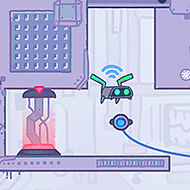
 Puzzle































 2696
2696


