
 For Boys
 For Girls
 For Kids
 Top Games
 My Games
 Top Games
 My Games


Bubble Shooter Game Online

Description
You line up a shot, watch the trajectory guide bend off the side wall, and let go a half-second before you’re actually sure — and somehow it clears three rows at once. That mix of calculation and gut instinct is the entire pull of Bubble Shooter, a game that looks like a five-minute time-killer but quietly demands real spatial planning once the board fills in.
| Genre | Match-3 puzzle / bubble-popping |
| Core mechanic | Matching three or more same-colored bubbles by launching from a fixed shooter |
| Special bubbles | Rainbow Bubble, Bomb Bubble |
| Win condition | Clear the board before bubbles reach the bottom line |
The Launcher and the Wall Bounce
Every round of Bubble Shooter starts the same way — a single launcher at the bottom of the screen, a queue showing your next bubble, and a ceiling of packed color clusters waiting to be broken apart. What separates a casual player from someone who clears boards consistently is whether they treat the side walls as obstacles or as tools.
Wall bounces let you reach clusters a straight shot physically can’t touch. Early in the game this barely matters, since most clusters sit in direct line of sight. Once rows multiply and gaps get narrow, bounced shots become the only way to hit a color pocket tucked behind a dead zone of mismatched bubbles.
Aim assist lines help here, but they only show the first bounce clearly — anything beyond a double bounce is where genuine skill takes over, and it’s the single biggest gap between someone who plays occasionally and someone who’s put real hours into Bubble Shooter.
Chain Reactions and Why Popping Isn’t Enough
A basic three-match pops the bubbles you hit. A well-placed shot into the right spot triggers a chain reaction, where bubbles that lose their connection to the ceiling drop away in bulk. This is the actual scoring engine of the game, not the individual matches.
Beginners chase the closest match every time. Regulars scan for the shot that detaches the largest disconnected cluster, even if that means ignoring an easy match sitting right in front of the launcher. Passing on the obvious shot to set up a bigger drop is a habit that takes a while to build, because it feels counterintuitive to skip a “free” match.
The Bomb Bubble accelerates this — it clears a radius around wherever it lands regardless of color, which makes it the go-to tool for breaking up a board that’s gotten too tangled to chain naturally. The Rainbow Bubble works differently, matching whatever color it touches, and saving it for a tight three-color deadlock is usually smarter than spending it the moment you draw it.
Managing the Descending Ceiling
Once you clear enough shots without popping anything, the entire bubble ceiling drops a row. This single mechanic is what turns Bubble Shooter from a relaxed puzzle into a genuine pressure game, because it punishes wasted shots far more than it punishes slow ones.
New players often rush, firing quickly to avoid the drop, which ironically causes more drops because rushed shots miss more often. Slower, deliberate players who take an extra second to plan a chain tend to survive longer boards precisely because every shot counts toward clearing rather than just filling space.
By the time the board reaches its later, denser stages, a single missed read on a wall bounce can cost you the run. This is the moment where color-blind-friendly players in the community often mention relying on shape or pattern cues rather than color alone, since dense boards with similar shades can genuinely be hard to parse at speed.
Community Habits Worth Picking Up
- Save special bubbles for deadlocks instead of using them on convenient but low-value matches
- Track the “next bubble” preview a full shot ahead rather than reacting to it in the moment
- Treat any shot that doesn’t pop anything as a small loss, since it moves the ceiling closer
- Practice bounce shots on early, low-pressure boards before relying on them under a descending ceiling
Some players find the descending ceiling mechanic frustrating rather than tense, especially on boards where the starting layout leaves very few clean matches — it’s a genuinely divisive part of Bubble Shooter, and even longtime fans admit certain board seeds feel unfair before you’ve thrown a single shot.
Frequently Asked Questions
- Why do my bubbles sometimes not match even though the colors look identical? Bubble Shooter uses fixed color categories rather than shade gradients, so two bubbles that look close under certain screen brightness settings may actually belong to different categories — checking under default display settings usually resolves this.
- What’s the best way to use the Rainbow Bubble? Hold it for situations where you’re down to two or three colors left on the board and none of them form a clean three-match on their own, since a Rainbow Bubble spent early is often wasted on a match you could have made anyway.
- Does the ceiling always drop at a fixed rate? No — the drop is tied to your shot count rather than a timer, which means playing slower doesn’t protect you from it; only landing matches does.
Bubble Shooter rewards the same instinct every single round — read the board before you read the shot — and whether you’re chasing a Bomb Bubble combo or threading a bounce around a dead cluster, that one habit is what turns a five-minute session into an hour you didn’t plan for.

 11
11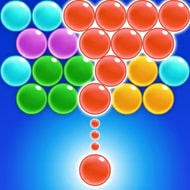
 Puzzle
























 2680
2680


