
 For Boys
 For Girls
 For Kids
 Top Games
 My Games
 Top Games
 My Games


Tube Jumpers Game Online

Description
In Tube Jumpers you start balanced on a floating tube with up to three rivals nearby, and that starting position matters the moment the first rock comes flying in. This is a local skill game built around one simple rule: stay on your tube, knock everyone else off theirs, and be the last one still floating when the water settles.
Staying Afloat: The Core Mechanic in Tube Jumpers
Movement comes down to a single button press that launches you upward and forward, letting you clear incoming hazards and reposition on your tube before the next threat arrives. There’s no complex combo system here — the entire skill ceiling is built on timing that one jump correctly against rocks, balls, and sharks that don’t follow a fixed pattern from match to match.
Landing safely after a jump matters just as much as making it in the first place. Come down at a bad angle or on the wrong side of your tube, and you’re left wobbling right as the next hazard arrives, which is usually how close matches actually end. The game punishes greedy, back-to-back jumps almost as much as it punishes standing still.
Up to four players can compete on the same device, and that local multiplayer setup is really the whole point of the game. Playing against three friends turns a simple dodging mechanic into a scramble where you’re watching hazards and rivals at the same time, and a jump timed for a rock can just as easily land you on top of an opponent’s tube.
Reading the Water: Rocks, Balls, and Sharks
Each hazard in Tube Jumpers demands a different read. Rocks tend to arrive in a straight, predictable arc, which makes them the easiest threat to plan around once you’ve seen a few. Balls bounce unpredictably off the water’s surface, so timing a jump against one often means guessing where it’ll be a half-second later rather than reacting to where it is now.
Sharks are the hazard players talk about most, since they move differently than the rocks and balls and punish anyone who’s timing their jumps purely by rhythm instead of watching the water. A shark can surface right as you’re mid-air, turning what looked like a safe jump into a costly landing.
Recognizing which hazard is coming, and adjusting your jump height and timing for that specific threat instead of using the same reflex every time, is the difference between players who survive a full match and players who get knocked off in the first wave of chaos.
What Trips Up New Players in Tube Jumpers
New players tend to hit the jump button constantly out of nervousness, which leaves them airborne too often and unable to react when a second hazard appears right after the first. Over-jumping is the single most common reason a first attempt ends early, and it’s an easy habit to unlearn once you notice it.
It’s also easy to focus only on rocks and sharks and forget that other players can knock you off your tube too, especially in the four-player free-for-all where someone else’s jump can land squarely where you’re about to be. Ignoring rivals is a mistake that only shows up once the hazard count gets high enough to demand full attention elsewhere.
A third habit worth breaking is jumping too early out of caution. Committing to a jump before a hazard is actually close enough to matter wastes the window where you’d otherwise have room to react to whatever comes next, and in Tube Jumpers that wasted window is often what costs a round.
How Tube Jumpers Gets Harder as Matches Continue
Early rounds are forgiving, with hazards spaced out enough to react calmly and reset between threats. As a match goes on, the pace tightens, and rocks, balls, and sharks start arriving close enough together that a single jump has to account for more than one threat at once.
Competitive players tend to play more conservatively as the field narrows, since being the last one on a tube is worth more than an aggressive early lead. Casual players, by contrast, often play loose from the start and rely on luck to survive the increasingly stacked hazards that show up later in a match, and that mismatch in approach is part of what makes mixed-skill lobbies interesting.
By the point where two players remain, hazard density is high enough that most matches come down to a single mistimed jump rather than a clear skill gap. That final stretch, players versus water versus each other, is the part of Tube Jumpers people remember most.
The Local Multiplayer Debate in Tube Jumpers
The four-player format is where Tube Jumpers is most divisive among players. Some enjoy the chaos of watching rivals get knocked off mid-jump, treating the crowded screen as part of the fun rather than a flaw. Others find that too many bodies on screen makes it hard to track your own tube in the later, faster stretches of a match, and that criticism comes up often enough to be worth acknowledging honestly.
Two-player matches sidestep that complaint almost entirely, since there’s more visual space to track a single rival alongside the hazards. Four-player games trade that clarity for higher stakes and more unpredictable finishes, which is exactly why groups of friends tend to gravitate toward the bigger lobby despite the added visual noise.
Whichever player count you choose, the underlying rule stays the same: one button, one tube, and a water’s worth of hazards that don’t care how many friends are watching you get knocked off.
Tube Jumpers keeps its rules simple enough to explain in a sentence, but staying on your tube against three rivals, a shark, and a screen full of rocks is what actually gives the game its replay value, and that single-button tension is what keeps four-player lobbies coming back for one more round.

 12
12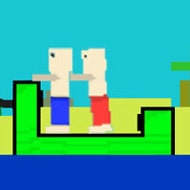
 For Boys
  For Girls
































 2682
2682


