
 For Boys
 For Girls
 For Kids
 Top Games
 My Games
 Top Games
 My Games


Tricky Towers Game Online
Description
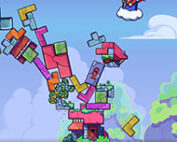
Tricky Towers looks like a cute, colorful spin on Tetris, all soft pastels and bouncing tetrominoes. It plays like an engineering exam run by a physics engine that actively resents you. Bricks don’t lock into place the way they do in a normal stacking puzzle — they wobble, they tip, and a single misjudged rotation late in a match can send an entire tower of careful work crashing to the ground.
| Genre | Physics Puzzle |
| Players | 1–4, local and online |
| Modes | Race, Survival, Puzzle |
| Core Mechanic | Physics-based tetromino stacking with magic spells |
Tetromino Physics in Tricky Towers
The seven familiar tetromino shapes from Tetris all appear here, but the resemblance ends the moment a piece touches your tower. Instead of snapping into a grid, bricks in the game respond to gravity and momentum the instant they land. A slightly off-center drop can leave a piece leaning at an angle that destabilizes everything below it, and pieces move in half-square increments rather than whole tiles, which makes fine positioning far more delicate than Tetris veterans expect.
Players who came in expecting their Tetris instincts to transfer directly are usually the ones who get caught off guard first. Stacking cleanly is still useful, but it’s no longer sufficient on its own.
This is the detail longtime fans always mention: the wobble isn’t cosmetic. It’s load-bearing, and by the time a tower reaches ten or twelve bricks high, even a gentle breeze effect can make the whole structure sway visibly before it settles or collapses.
Light and Dark Magic Spells in Tricky Towers
Scattered through every match are magic spells split into two opposing categories. Light magic reinforces your own tower — spells like Ivy wrap vines around bricks to bind them together, while Petrify hardens a section so it stops responding to physics entirely for a few seconds. Dark magic works the opposite way, aimed squarely at opponents: a spell that enlarges an incoming brick can overload a rival’s foundation instantly, and other spells restrict rotation or bury a piece under obstructions right when precision matters most.
Casting a light spell temporarily locks you out of casting a dark one for a short window afterward, so every cast is a real choice between shoring up your own structure or sabotaging someone else’s.
Players who lean aggressive tend to hoard dark spells for the moment an opponent’s tower looks most fragile, while more defensive players spend theirs early to build a stable base they don’t have to think about later.
The spell system is easily the most debated part of the game in online discussions. Some players feel a well-timed dark spell can undo several minutes of careful stacking in a single cast, which turns a close match into a coin flip.
Race Mode versus Survival Mode
Race mode is a straightforward sprint: build a tower tall enough to pass a finish line marker before the timer runs out or before an opponent does it first. It rewards speed and efficient piece placement over cautious perfectionism, since a slightly wobbly tower that clears the line still wins.
Survival flips that priority entirely. Each player starts with three hearts, and dropping a brick — or losing a whole chunk of your tower to a collapse — costs one. The mode punishes recklessness far more than Race does, and a single greedy placement late in a match can end a run that had gone perfectly up to that point.
Newer players often bring Race-mode instincts into Survival and pay for it immediately, since the two modes reward almost opposite playstyles.
The Puzzle Mode and the Laser
Puzzle mode swaps the vertical race entirely for a slower, more deliberate challenge. Players are given a predetermined set of bricks and must fit as many as possible into a tower without touching a horizontal laser beam positioned above the play field. There’s no timer pressure here, just the geometry problem of arranging a fixed set of pieces into a stable shape that stays beneath the cutoff.
- Predetermined brick order removes randomness from the equation
- Touching the laser in single-player trials ends the attempt immediately
- In multiplayer, touching the laser instead boosts the whole tower upward, which usually backfires
Community discussion around Puzzle mode is split almost down the middle. A good portion of players consider it the best mode in the whole game precisely because it removes the luck-of-the-draw element that Race and Survival both carry. Others find it too slow compared to the chaos of the other two modes, and some matches can genuinely take 30 minutes or more to solve on the harder trials.
Common Mistakes New Players Make
The most frequent early mistake is treating every brick placement like Tetris, dropping pieces straight down without accounting for how much a tower leans after each addition. A second common error is hoarding spells instead of using them, since an unused Light spell does nothing sitting in reserve while an opponent’s tower quietly climbs past yours.
Players who enjoy methodical, planning-heavy games gravitate toward Puzzle mode almost immediately, while those who prefer constant pressure and quick decisions tend to stick with Race.
A third mistake, easy to overlook, is ignoring the wind effect that appears periodically in matches — it pushes falling bricks off their intended line just enough to matter on a tall, thin tower.
Advanced Tower Engineering Techniques
Once the basics click, the deeper skill in Tricky Towers is building a wide, stable base early and tapering the tower as it climbs, rather than stacking a uniform column that becomes top-heavy. Cantilevering bricks out past the edge of the tower below them can gain height quickly, but it’s a technique that fails badly the moment a Dark spell disturbs the structure mid-lean.
Skilled players also learn to bait opponents into casting spells early, since the temporary spell lockout that follows any cast is a window where a rival’s tower is briefly undefended.
- How do I stop my tower from tipping over on tall builds? Widen the base in the first several bricks rather than stacking straight up — a tower with a broad footprint tolerates far more lean before it actually collapses.
- What’s the difference between Trials and Endless Trials in single-player? Trials pit you against an opposing mage casting spells against you, while Endless Trials strip the mage out entirely and simply test how high you can build before running out of hearts or bricks.
- Is Puzzle mode worth learning if I mainly play Race and Survival? Yes — the laser-based placement puzzles teach spatial reasoning about tetromino fit that transfers directly into faster, cleaner stacking in the other two modes.
Tricky Towers keeps its appeal because no two towers ever fail the same way twice, and whether it’s a Dark spell catching your foundation off guard or a gust of wind nudging a piece past the laser in Puzzle mode, the physics engine always has the last word.

 30
30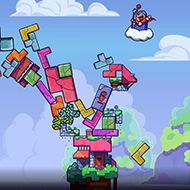
 4 Player
  Puzzle














 2677
2677


