
 For Boys
 For Girls
 For Kids
 Top Games
 My Games
 Top Games
 My Games


Battle Of Dots : The Last Stand Game Online

Description
Battle Of Dots: The Last Stand looks like colored circles bumping into each other on an empty battlefield, but it plays like a real-time tactics game built around split-second decisions. You’re not watching an auto-battler resolve itself — you’re directly controlling units, reacting to enemy movement, and adjusting a plan that can fall apart the moment you look away.
| Genre | Real-time tactics |
| Setting | Abstract battlefield with opposing armies |
| Status | Active development |
| Core Mechanic | Direct control of individual units mid-battle |
Black Armies, White Armies, and Nothing Else Yet
Right now, battles in the game are fought between two sides only — a black army and a white army. It’s a deliberately stripped-down setup, and the developers have been clear that more factions, nation-based systems, and larger-scale battles are planned rather than already delivered.
That simplicity works in the game’s favor for now. With only two visual sides to track, it’s easier to read a chaotic battlefield at a glance, which matters when you’re managing snipers, cavalry, and infantry at the same time.
Players who came in expecting a full roster of nations or nuanced faction identities should know that’s a future goal, not a current feature — the two-color setup is where the project currently stands.
Commanding Infantry, Cavalry, Snipers, and Artillery in Battle Of Dots
Unit variety is where most of the tactical depth lives. Infantry hold ground and trade fire at close range. Cavalry move fast enough to punish an exposed flank before the enemy can react. Snipers and artillery hang back and rely on range, and a supporting general unit extends buffs to nearby troops within a set support radius.
New players commonly report confusion when snipers or artillery units simply don’t fire during a battle. In most cases this comes down to line of sight or positioning rather than a bug — ranged units in Battle Of Dots: The Last Stand need a clear angle and proper placement before they’ll engage, and stacking them behind your own infantry can quietly disable them for an entire fight.
Once you start treating unit placement as seriously as unit selection, engagements stop feeling random and start feeling like something you can actually plan around.
Positioning Your Army Before the First Shot
A pre-battle deployment phase lets you freely place your soldiers before combat begins, which is a meaningful addition over earlier versions where formations were locked in from the start. Taking that setup seriously — spreading cavalry wide, keeping artillery behind a screen of infantry — tends to matter more than any single decision made once shooting starts.
Being able to pause mid-battle to reassess also changes how forgiving the game feels. It gives you room to correct a formation that’s about to collapse instead of watching it happen in real time with no way to intervene.
Early in the game, before you’ve learned how the AI responds to gaps in your line, this pause function is often the difference between a costly mistake and a recoverable one.
Why the Enemy AI Retreats Instead of Standing Its Ground
A retreating mechanic lets AI-controlled units withdraw when a fight turns against them, rather than fighting to the last dot in every engagement. Combined with reworked situation evaluation, enemy forces now behave with more restraint, pulling support units back and regrouping instead of committing everything at once.
That shift changes how a battle in Battle Of Dots: The Last Stand actually plays out. Chasing a retreating enemy line can expose your own flanks, so the smarter AI rewards patience over aggression more than earlier builds did.
It’s a meaningful step up from AI that simply rushes forward, and it’s one of the changes players discuss most often when comparing older and newer versions of the game.
Flanking and the Fixes Players Actually Notice
Flanking now matters in a way it previously didn’t, with enemy forces capable of maneuvering around static positions rather than marching straight into them. That alone forces more deliberate positioning than the earlier, more predictable AI patterns players had grown used to.
Pathfinding improvements have also reduced the number of units getting stuck on terrain or bunching up mid-move, a complaint that showed up regularly in earlier feedback threads.
None of these changes are dramatic on their own, but together they’ve noticeably shifted how a typical engagement unfolds compared to earlier builds.
What Battle Of Dots: The Last Stand Still Doesn’t Explain
The most consistent criticism from players isn’t about balance or AI — it’s about the lack of in-game explanation. Several players have described genuinely enjoying the core battles while still being unsure how certain systems, like the supporting general’s buff radius, actually function without outside help.
An in-game controls overview has since been added, which helps with the basics, but deeper systems still rely heavily on trial and error or checking the community Discord for clarification.
For a project still early in development, that’s an understandable gap rather than a fatal flaw, but it’s honest to say new players will spend real time guessing before things click.
Sandbox Mode Versus Battle Mode
Alongside the main battle mode, a sandbox mode lets players experiment with formations and unit combinations outside of a scored engagement. It’s a useful space for testing how infantry, cavalry, and ranged units interact before committing to a real fight where a bad formation can cost the entire army.
Players who bounce off the trial-and-error nature of the main mode often end up spending more time here than expected, treating it as a low-stakes way to learn the systems the game doesn’t spell out directly.
Fake Mobile Downloads and a Different Game With a Similar Name
Two points of confusion come up often enough to be worth addressing directly. First, Battle Of Dots: The Last Stand has no connection to a separate, similarly named game on Steam — they’re unrelated projects despite the overlapping branding. Second, there is currently no official mobile version, and any APK claiming to be one should be treated as fake until an official release is announced through the game’s own channels.
Both points come up regularly enough in player discussions that they’re worth knowing before searching for the game anywhere outside its official pages.
Battle Of Dots: The Last Stand is still rough around the edges in places that matter — a supporting general whose range needed multiple fixes, systems that go unexplained until you stumble into a Discord thread, unit types still limited to two colored armies. But the tactical core, where flanking, retreating, and careful placement of infantry and artillery genuinely decide a battle, already works well enough to make the rough edges feel like a development stage rather than a design flaw.

 27
27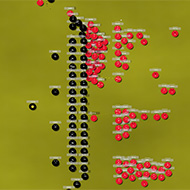
 For Boys
  For Girls
































 2678
2678


