
 For Boys
 For Girls
 For Kids
 Top Games
 My Games
 Top Games
 My Games


Time To Waste Game Online
Description
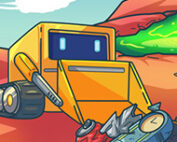
In Time To Waste you start with a single bot, one grid-based map, and an entire planet buried under trash, which matters because everything you do from that point on is about turning that mess into a system that runs itself. There’s no story dump before you’re moving — you’re just dropped onto the surface with a claw, a scrap counter at zero, and a whole biome that needs clearing.
| Genre | Casual Incremental |
| Core Loop | Grid-based scrap collection and upgrades |
| Bots Available | 3 |
| Planets | 3 |
| Upgrades | 80 |
| Typical Playtime | 30–60 minutes |
Grid Movement and the First Bot in Time To Waste
The core mechanic is simple to describe and slower to master: your bot moves tile by tile across a grid, sucking up scrap as it rolls over it, and every piece collected feeds a currency you dump straight back into upgrades. Early sessions are almost entirely manual — you’re steering, backtracking for scrap you missed, and learning which corners of the map refill fastest. It plays like a game of patient sweeping before it becomes anything resembling automation.
Most beginners waste their first real currency spike on cosmetic-feeling upgrades instead of movement speed or collection radius, which are the two stats that actually compound. Because collection is grid-based, a wider radius means fewer wasted tiles per pass, and that difference snowballs over an hour of play far more than a flashier early purchase.
Idle-leaning players tend to get frustrated here, since the opening stretch genuinely wants your attention. Active-play fans, on the other hand, describe this early phase as the most satisfying part of the whole loop — there’s a rhythm to routing your bot around a pile that rewards planning ahead rather than mashing a button.
Turning Scrap Into an Upgrade Tree
Once you’ve got a scrap cushion, the upgrade tree opens up branching paths for speed, capacity, radius, and eventually a second bot slot. The tree isn’t laid out purely by tier — some players notice upgrade titles don’t track cleanly with unlock order, since costs scale procedurally rather than in a strict ladder. That’s a small but real point of confusion the community brings up regularly.
By the time you’ve unlocked your second bot, you’re managing two collection loops instead of one, and that’s usually where the game stops feeling like a single-task chore and starts feeling like light logistics.
- Collection radius upgrades reduce wasted movement more than raw speed does early on
- A second bot roughly doubles throughput but also doubles the babysitting, until automation catches up
- Currency conversion rates shift as you cross planets, so early-game math stops applying later
When Automation Changes the Pace of Time To Waste
The self-driving upgrade is the mechanical turning point. Once unlocked, your bot pathfinds on its own, and the whole feel of the game shifts from active sweeping to something closer to supervision. Reaching it takes a real chunk of the demo’s 30 to 60 minute runtime, which is intentional — it’s the reward for getting through the manual grind rather than a starting option.
Full idle mode sits one step further out, letting the game run in the background while scrap accumulates without a human hand on the controls at all. Idle-focused players treat this as the actual endgame; active-play players sometimes stop here, since watching the bot work removes the part of the loop they liked.
Biomes, Volcanoes, and the Trash That Keeps Coming
Different biomes introduce different trash types — a volcanic zone spits out scorched debris in short bursts, while a polluted river biome spreads scrap thin across a wider area, which changes how radius upgrades perform. Once you reach a new biome, the collection habits that worked on the first planet stop being optimal, and that’s the one observation that only becomes obvious from actually playing rather than reading about it: the game quietly re-teaches its own loop every time the terrain changes.
The demo currently offers three planets. Whether the full release adds meaningfully different biome mechanics beyond re-skinned trash types is the most common open question in comment sections right now, and it’s a fair one — the loop is satisfying, but its long-term depth hasn’t been proven yet across a full release.
Is the idle mode worth switching to early?
Not immediately. Idle mode pays off once your upgrade tree is deep enough that passive collection actually adds up to something, which for most players lines up with unlocking the second bot slot.
What does the self-driving upgrade actually change?
It hands pathfinding over to the bot itself, turning Time To Waste from a game you steer into one you mostly watch and periodically redirect toward new upgrades.
How long does a full demo run take?
Most players clear the current build in 30 to 60 minutes, though that stretches if you’re chasing every upgrade rather than racing toward automation.
Time To Waste earns its title honestly — it’s a game about doing very little, very deliberately, until a self-driving bot is doing the deliberate part for you, and that transition from manual sweeping to hands-off automation is the whole reason to stick with it past the first planet.

 36
36
 1 Player
  For Boys
  For Girls
































 2680
2680


