
 For Boys
 For Girls
 For Kids
 Top Games
 My Games
 Top Games
 My Games


DUBHouse Game Online
Description
You drop into a lobby with three friends scattered across three different laptops, nobody in the same room, and the host reads out a string of numbers like a phone code from the ’90s. A few seconds later everyone is staring at the same paused clip of a man in a lab coat mid-sentence, and nobody knows what he’s about to say — because in DUBHouse the whole point is that you never hear the original line before you record over it.
| Genre | Voice dubbing party game |
| Platforms | Windows, macOS, Linux |
| Player Count | 1 to 8 |
| Session Length | A few minutes per scene |
Claiming a Character in a DUBHouse Lobby
One person hosts, everyone else joins using the local address the game displays on screen, and from there each player claims a character in whatever scene the host has loaded. That claim matters more than it sounds like it should: once you’ve taken a character, you’re only responsible for their lines, and the game doesn’t let you sneak in extra dialogue for someone else’s part. Watch the scene once, record your take when it plays back, and wait.
The waiting is where DUBHouse quietly does its best work. When the last player finishes their line, the game doesn’t just play everyone’s audio back in isolation — it mixes every performance into a single video and the whole lobby watches it together, in sync, at the same time. That shared payoff is the actual game. Nobody sees their own line played back to them privately; it lands in front of the group, cold, the same way a joke lands better when the room hears it together instead of one at a time.
If a line comes out wrong, nothing forces you to live with it. Hitting Record again replaces just that take, and New scene resets the whole group into a fresh clip without anyone needing to back out of the lobby. Newer players tend to under-use both buttons in the first session or two — they’ll sit through a flubbed line rather than redo it, mostly because they don’t realize redoing a single line doesn’t disturb anyone else’s already-finished take.
What the Clip Maker Actually Builds
DUBHouse ships with no scenes at all. That surprises a lot of first-time players who expect a library of pre-made clips waiting for them, and it’s arguably the single biggest thing to understand before buying: you are expected to bring your own video, or get a pack from somewhere else. The tool for building your own is the Clip Maker, currently in beta, and it’s more capable than the “drop a file in” description makes it sound.
- Drop in any video file and the Clip Maker treats it as raw material for a scene.
- Mark where each line starts and ends, then assign a character name to it.
- The tool lifts the original dialogue out of the audio track on its own, so music and sound effects keep running underneath instead of the whole clip going silent where a line used to be.
That last part is the detail that makes homemade scenes feel usable rather than janky. A clip with a music bed or ambient sound doesn’t turn into dead air every time a character is about to speak — the Clip Maker isolates just the voice, so your recorded line sits on top of the same soundscape the original had.
Reading the Scope Before You Hit Record
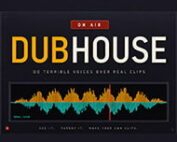
DUBHouse gives you a visual called the scope while you record: the original line’s waveform sits above the timeline, and your take builds in underneath it as you speak, on the exact same clock. It’s the fastest way to tell you came in a half-second early or trailed off after the original actor had already stopped moving their mouth. Pairing that with the count-in and a bit of input gain adjustment in audio settings is the difference between a take that syncs and one that visibly doesn’t.
Noise suppression runs underneath all of this without much setup. It listens for about two seconds before you start, learns what your room’s fan or PC hum sounds like, and subtracts exactly that instead of guessing at a generic profile — DUBHouse’s own materials cite up to 42 dB removed this way. Voice matching then levels out the difference between whoever’s mic runs quiet and whoever’s runs hot, so the final mixed video doesn’t have one player shouting over another.
Getting a Remote Group Into the Same Scene
Local hosting only gets you as far as people on the same network, so the host reads out the address the game shows and everyone types it in. Playing with people scattered across cities means routing through a shared VPN tool — Radmin, Tailscale, and Hamachi all get named in DUBHouse’s own setup notes — with the host reading out that VPN address instead of the raw local one, and allowing a firewall prompt once when it appears.
Guests don’t need to manually import anything the host built in the Clip Maker. If someone’s missing the scene the host has loaded, they get a Download this pack from the host button, and only the host ever has to do the actual importing on their end.
Does cross play work between Windows, Mac, and Linux in DUBHouse?
Yes — a host on any of the three supported platforms can run a lobby that Windows, Mac, and Linux players join together, since the connection runs over a shared local address or VPN rather than anything platform-locked.
Why won’t DUBHouse open on Mac the first time?
The build isn’t code-signed, so macOS blocks it by default on first launch. Right-clicking the app and choosing Open — rather than double-clicking — gets past the warning; double-clicking just repeats the error.
Can I use packs that weren’t made in the Clip Maker?
DUBHouse reads the same folder layout that Choicer Voicer packs use, including captions, timestamps, and character data, so compatible packs can be dropped into the scenes folder or brought in through Voice Packs → Import pack folder without rebuilding them from scratch.
What actually makes DUBHouse work as a party game isn’t the recording itself — plenty of tools let you record over a video — it’s that nobody hears a line until the group hears the finished mix together, characters and all, off whatever clip the host loaded into the Clip Maker that night.

 35
35
 For Boys
  For Girls





























 2697
2697


