
 For Boys
 For Girls
 For Kids
 Top Games
 My Games
 Top Games
 My Games


Her Trees: Puzzle Dream Game Online
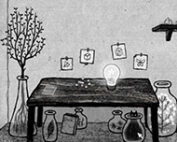
Description
Nothing in Her Trees: Puzzle Dream ever tells you the rules. Every one of its puzzles hides an answer in plain sight — a sequence of letters buried inside overlapping leaves, paper scraps, or petals — and the only way to find it is to drag things around until the pattern clicks into place on its own.
| Genre | Point-and-click puzzle |
| Perspective | Single-screen scenes |
| Number of puzzles | 43 |
| Series entry | Third, playable standalone |
The Core Loop of Her Trees: Puzzle Dream
Every scene in Her Trees: Puzzle Dream follows the same rhythm without ever announcing it. You look at a cluttered arrangement of objects — branches, folded paper, jars, scattered petals — and start dragging things over one another until something that wasn’t visible before starts to surface. There’s no highlight when you hover over the correct object, no snapping into place, and no confirmation sound telling you you’re on the right track. The game trusts you to notice the moment a shape resolves into something legible.
This design choice is the single biggest thing players either fall in love with or bounce off within the first ten minutes. Fans of quiet, observation-driven puzzle games tend to describe the lack of feedback as freeing, since it removes the temptation to brute-force a solution and forces genuine looking instead. Players coming from more conventional puzzle formats, expecting a hint arrow or a glowing outline, sometimes spend the opening puzzle unsure whether they’re even doing the right thing before the logic clicks.
Once a puzzle resolves, the payoff is small but consistent: a flower bud sprouts somewhere on a nearby tree, marking your progress without interrupting the quiet pacing the rest of the game maintains. By the time you’ve cleared a dozen or so scenes, watching those buds accumulate becomes its own kind of scorekeeping, even though Her Trees: Puzzle Dream never frames it as one.
Reading Letters Hidden in the Scene
The specific mechanic underneath almost every puzzle is letter-finding. Objects layered on top of each other — a leafy branch crossing another at an angle, a torn page half-covering a second sheet — conceal individual letters that only become readable once you’ve moved the right pieces out of the way or lined them up correctly. Once you’ve spotted enough letters, you type or click the resulting sequence into a small grid positioned near the scene, and a correct answer moves you forward.
What makes this more interesting than a standard hidden-object search is that the letters don’t spell anything on their own. There’s no secret word waiting to be decoded, no narrative payoff hidden in the sequence itself — the letters exist purely as the game’s way of confirming you’ve correctly interpreted the spatial relationship in front of you. Players who go in expecting a cipher to crack sometimes feel a flicker of disappointment when they realize the sequence is functionally arbitrary, but most come around to appreciating that the real puzzle was always the observation, not the code.
Later puzzles complicate this by layering three or four spatial relationships into a single scene rather than one obvious overlap. A branch might need repositioning before a jar behind it becomes relevant, which itself needs rotating before a petal underneath aligns correctly. Completionist players chasing all 43 puzzles in one sitting tend to slow down considerably once these compound scenes start appearing, since skimming the way you might in an earlier, simpler room stops working.
What Happens When You Get Stuck
Her Trees: Puzzle Dream includes a built-in safety net for exactly the moments its own design creates. Spend long enough on a single puzzle without progress, and the game quietly shifts into what players in the community refer to as stuck mode, where a hint timer starts counting down toward a nudge in the right direction. It’s a low-friction system — you’re never explicitly told you’ve failed, and nothing about the pacing changes elsewhere in the scene while it’s running in the background.
This matters more than it might sound like, because the game’s total absence of tutorializing means genuinely new players can hit a wall on puzzles that experienced point-and-click fans would consider straightforward. The hint timer keeps that wall from becoming a hard stop. Players unfamiliar with genre conventions from Rusty Lake or Cube Escape–style rooms, who might otherwise abandon a puzzle out of frustration, tend to rely on stuck mode noticeably more than veterans of the format.
Stuck mode is the game’s only concession to difficulty accessibility, and it’s worth understanding early rather than discovering by accident twenty minutes into your first genuinely hard room. Rather than punishing hesitation, it rewards patience — the timer only starts once you’ve clearly stalled, not the moment a puzzle begins.
Difficulty Balance Across 43 Puzzles in Her Trees: Puzzle Dream
As the largest entry in the series, Her Trees: Puzzle Dream doesn’t ramp its difficulty in a straight line, and that’s one of the more honestly debated aspects of the design among players. Some early rooms resolve within a minute or two of casual dragging, while a handful of mid-game and late-game scenes stack enough overlapping relationships that even attentive players report sitting with a single puzzle for considerably longer than the surrounding ones.
Reactions to this unevenness split fairly evenly. Players who treat each puzzle as a self-contained meditative exercise tend not to mind the inconsistency, since a quick win after a long one still feels satisfying rather than deflating. Players expecting a steadily escalating challenge curve, the kind more common in traditional logic puzzle games, sometimes find the sudden spikes jarring, especially once they’ve settled into a rhythm across a run of easier rooms.
By the time you reach the puzzles built around petal alignment — one of the visual tricks unique to this entry rather than carried over from the earlier games in the series — the difficulty curve has clearly shifted from “observe and drag” to something closer to genuine spatial reasoning, and it’s a fair marker for how much harder the back third of the game gets compared to its opening.
How many puzzles does Her Trees: Puzzle Dream have, and how long does it take to finish? The full game contains 43 hand-crafted puzzles, more than the first two entries in the series combined, and most players report a completion time somewhere between one and a half and three hours depending on how often stuck mode’s hint timer gets used along the way. Do you need to play the earlier Her Trees games first? No — Her Trees: Puzzle Dream is designed to work as a standalone entry, and its core drag-and-overlap mechanic is explained entirely through play rather than through story continuity from the earlier titles in the series. What do the flower buds on the trees actually track? Each flower bud that sprouts marks a solved puzzle, functioning as the game’s only visible form of progress tracking across its otherwise scoreless, timer-free structure.
Whether you’re chasing every one of the 43 puzzles in one sitting or letting stuck mode carry you through the harder petal-alignment rooms one flower bud at a time, Her Trees: Puzzle Dream keeps rewarding the same instinct throughout — stop looking for instructions, and start actually looking at the scene in front of you.

 70
70
 For Boys
  For Girls
  Puzzle


























 2697
2697


