

 For Boys
 For Girls
 For Kids
 Top Games
 My Games
 Top Games
 My Games


FNAF: Scary Pizzeria 3D Game Online
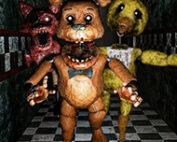
Description
You wake up on the floor of a dining room that shouldn’t exist, flashlight battery already ticking down, and the only thing in your pocket is a notepad with a checklist half-filled in handwriting that isn’t yours. That’s the opening minute of FNAF: Scary Pizzeria 3D, and it doesn’t slow down from there. There’s no tutorial popup walking you through the controls, no safe first hour to get your bearings — just a warped version of Freddy Fazbear’s Pizza and a five-hour countdown to 6 AM that starts the second you can move.
| Genre | Free-roam survival horror |
| Setting | Freddy Fazbear’s Pizza (nightmare version) |
| Playable Character | Michael Afton |
| Core Loop | Hourly objectives via notepad checklist |
| Survival Window | Five in-game hours until 6 AM |
Michael Afton’s Nightmare in FNAF: Scary Pizzeria 3D
The plot is simple on paper and considerably less simple to sit through. Michael Afton falls asleep after a shift and wakes up trapped inside a twisted version of the pizzeria, guided hour by hour by a mysterious presence that only communicates through the notepad in his hands. The framing device matters more than it looks like it should, because it explains why nothing in this building follows normal logic — hallways loop, rooms rearrange, and the animatronics behave like they’re being puppeted by something with its own agenda rather than following a patrol pattern.
What sells the nightmare framing is how little exposition the game gives you about it. Nobody sits you down and explains Yelo Bear or why the souls of the animatronics are trapped here. You piece it together from environmental details and the notepad’s cryptic prompts, which is exactly how a lot of the FNAF fangame scene handles lore — sparse, implied, left for the community to argue over afterward.
By the time you’re deep into the third or fourth hour, the line between “nightmare logic” and “the game just wants to mess with you” gets deliberately blurry, and that ambiguity is part of what people remember most after finishing it.
The Notepad Checklist and Hourly Objectives
Every hour hands you a new checklist, and the game refuses to hold your hand while you work through it. The objectives rotate across a fixed pool rather than repeating the exact same task on a loop, which keeps early hours from feeling like busywork even though the underlying structure — find five things, survive to the next hour — stays constant. Typical tasks include:
- Restoring power after it’s cut, usually by tracking down a breaker in a room you haven’t fully explored yet
- Locating animatronic plushies hidden throughout the dining area and back rooms
- Collecting missing-child posters scattered in places that force you into animatronic territory
- Searching for unidentified body parts, one of the more unsettling objective types once you realize what they imply about the building’s history
None of this would matter much if the roaming threat weren’t reactive to how loudly and clumsily you move, but it is, so every objective becomes a small risk-reward calculation about whether to sprint for the next item or creep and lose time.
Yelo Bear and the Animatronic Cast
Yelo Bear is the figure running the show, framed as the entity who seized control of the animatronics’ souls and is using the pizzeria as a trap for Michael. Community reaction to Yelo Bear has genuinely split down the middle — plenty of players find the design and the buildup toward the character effective, while just as many think the payoff undersells the dread the earlier hours build, especially once you actually see the character in full during the later stretch. That’s a fair criticism, and it’s one of the more common threads in discussion around the game.
The supporting animatronic roster leans on familiar Freddy Fazbear’s Pizza faces, reworked with the same off-kilter, slightly-wrong aesthetic that defines the whole building. They don’t behave identically to each other — some are tied to specific rooms or triggers, others roam more freely as the hours progress, and learning which is which is most of what separates a clean run from a chaotic one.
Sound cues do a lot of the heavy lifting here. Long before you see anything moving, you’ll hear it, and learning to read those audio tells is the single biggest skill jump between someone’s first playthrough and their third.
Reaching the 3 AM Basement Sequence
The 3 AM mark is where FNAF: Scary Pizzeria 3D stops being a checklist-and-avoidance game and becomes something closer to a puzzle gauntlet. The basement sequence throws out the notepad-objective structure entirely and drops you into a generator room with a wall of buttons that need to be triggered in a specific configuration to restore power to the building. Early versions of this sequence had a reputation — deserved, by most accounts — for being borderline unreadable, with players convinced the level was bugged rather than just difficult.
Even in its more polished state, the basement remains the section players bring up most when the topic of difficulty spikes comes up. It’s a legitimate tonal and mechanical swerve.
Getting through it comes down to patience more than reflexes. Rushing the button sequence under pressure is how most first attempts end, and slowing down to actually read the room tends to matter more than raw speed once you’re this deep into the game.
Mistakes Beginners Make Early On
New players consistently underestimate how loud sprinting is relative to how much time it actually saves. Early in the game, when the roaming presence is less aggressive, that trade-off feels irrelevant — but the habits you build in hour one carry into hour three, when the same recklessness gets punished immediately. The players who finish clean runs are almost always the ones who treated every hour, not just the later ones, as if it already mattered.
The second common mistake is ignoring the notepad’s phrasing. The checklist prompts aren’t purely functional; some of them hint at nearby danger or a change in animatronic behavior, and players who treat the notepad as flavor text instead of a tool tend to walk into avoidable encounters.
There’s also a tendency to fixate on one objective type and neglect the clock, forgetting that the countdown to the next hour keeps running regardless of how thorough you’re being.
What Players Debate About FNAF: Scary Pizzeria 3D
The most consistent critique in the community is repetitiveness across the first three hours, where the core loop of gathering items and dodging roaming animatronics doesn’t evolve much before the basement sequence changes everything. Some players see that as a deliberate slow build that makes the 3 AM shift hit harder by contrast; others see it as padding. Both readings show up constantly in comment sections and playthrough videos.
There’s also a running debate about whether Yelo Bear earns the buildup given to the character across the earlier hours, with opinions genuinely split rather than leaning hard one way.
What almost nobody argues about is the atmosphere. Even critics of the pacing tend to agree the pizzeria itself — lighting, sound design, the sense that every room used to be something warmer — is doing exactly what it’s supposed to.
Is FNAF: Scary Pizzeria 3D connected to the mainline Five Nights at Freddy’s story?
It borrows Michael Afton as its protagonist and leans on established Freddy Fazbear’s Pizza iconography, but the nightmare scenario, Yelo Bear, and the notepad-driven objective system are original to this fangame rather than pulled from mainline canon.
What happens if you run out of time before finishing an hour’s checklist?
Failing to complete the objectives before the hour rolls over generally leaves you exposed to whatever roaming animatronic is active at that point, since the safety the checklist indirectly provides — knowing where threats aren’t — disappears once the hour resets around you.
Why does the 3 AM basement section feel so different from the rest of the game?
It swaps the free-roam, checklist-based loop for a contained puzzle built around a generator and a specific button sequence, which is why players who expected more of the same hourly structure tend to get caught off guard by it.
Strip away the jump scares and FNAF: Scary Pizzeria 3D is really a game about learning a building — where Yelo Bear’s influence is strongest, which hallway loops back on itself, when the notepad is warning you and when it’s just listing chores. That’s a slower kind of tension than most FNAF fangames go for, and it’s why the hours leading up to the basement generator sequence linger with people long after the credits roll.

 41
41






















 2694
2694


