
 For Boys
 For Girls
 For Kids
 Top Games
 My Games
 Top Games
 My Games


ROLLA Game Online
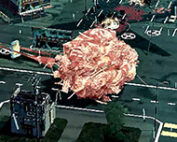
Description
ROLLA starts small and fast. In the first thirty seconds you are a compact mass of rolling flesh eating people in the street, moving at a speed that feels almost too quick to control. Within a minute you are large enough to eat a car. The question the game builds every mechanic around is whether you can stay large, because ROLLA’s enemies — cops, soldiers, government agents, and eventually airstrikes — are specifically designed to shrink you back down, and a smaller ROLLA is a faster ROLLA but a ROLLA that cannot eat buildings and cannot survive sustained fire. Size is not just a reward. Size is the whole game.
| Genre | B-Movie Horror Arcade / Destruction Survival |
| Platform | Windows (demo available) |
| Control Scheme | Single joystick + buttons, keyboard, or keyboard and mouse |
| Core Loop | Roll, eat, grow, survive, repeat |
| Setting | Multiple global locations, each with separate stage goals |
The Size Curve and What ROLLA Actually Demands
ROLLA describes itself as sitting somewhere between a run-based destruction survival game, a twin-stick shooter, and a collectathon, and that description is accurate in a way that sounds messier than the game plays. The core of ROLLA is a size economy: you grow by eating people and buildings, you shrink when bullets and fire connect, and the rate at which you gain versus lose mass determines whether any given stage becomes triumphant or catastrophic. Managing that economy is the skill ROLLA is teaching, even when it looks like the game is just asking you to roll around and eat things.
The key mechanical trade-off that beginners do not internalize quickly enough is the speed-size relationship. A small ROLLA moves fast. A large ROLLA is slow and occupies enough space that it becomes an enormous target for airstrikes, which call in bombing runs with target markers that appear on the ground before impact. Early in the game, when ROLLA is at its smallest, surviving requires using that speed to weave between gunfire and reach the people and objects that will grow you fast enough to become durable. Players who go large too slowly get chipped down by early enemies before they can absorb the hits. Players who go large too quickly without managing airstrike positioning find the screen full of bomb markers they cannot move out of.
The DASH ability is the mechanic that most players underuse in their first few stages. ROLLA can dash at short range, which covers ground faster than rolling speed allows and can close the gap to a food source or escape a tight cluster of flamethrower enemies that showed up in positions that feel unavoidable until you remember the dash exists. Players who treat ROLLA as purely a rolling game and forget dash is available consistently report dying to encounters that experienced players navigate in one or two inputs.
Enemies and the Airstrike Problem in ROLLA
The escalation of opposition in ROLLA follows a logic that the game does not spell out but that becomes clear through repetition: the smaller and faster forces — cops, first responders — appear first and are manageable through direct eating. Military units arrive once ROLLA has grown large enough to constitute a threat the local force cannot handle, and they introduce sustained ranged damage that requires movement discipline rather than just aggression. The airstrike is the hardest enemy to manage because it is not a character — it is a timed event that arrives regardless of what ROLLA is currently doing, and the target markers give you a window to move that is shorter than it first appears.
The SNATCH ability — ROLLA can pull people and objects toward itself from distance — becomes particularly useful against flamethrower units, which the ROLLA community has flagged as disproportionately dangerous in tight corridor sections because their damage output at close range shrinks ROLLA faster than any other ground enemy. Snatching them at range rather than rolling through their fire is the correct approach. Players who discover SNATCH only after struggling with flamethrowers describe a significant difficulty drop in those encounters once the ability is in regular use.
One detail that stands out on a first playthrough and that no tooltip prepares you for: the sound design when ROLLA absorbs a building is notably different from eating a person, heavier and with a bass register that communicates scale in a way the visuals alone do not fully achieve. It is the moment where the game feels like the B-movie it is referencing rather than just a game that references B-movies — the physical sensation of becoming something enormous is in the audio as much as the visuals.
Mutations, Powerups, and Hidden Stage Goals
Different stages in ROLLA offer different mutations and powerups, which is one of the game’s more interesting structural choices. Rather than a single upgrade tree that persists across stages, ROLLA varies what is available by location, which means a mutation that felt essential in one area may not exist in the next and players have to adapt their approach accordingly. Players who relied heavily on a specific powerup in early stages and then found it absent in later locations describe the adjustment as one of the game’s more demanding difficulty increases.
Every stage also carries separate hidden goals alongside the primary objective. Some of these are simple enough to complete naturally — destroy a specific number of buildings, reach a certain size threshold. Others are deliberately obscure and require players to investigate the stage’s geography or try approaches that are not obvious from the primary objective. The hidden goal structure gives ROLLA significant replay value for players who care about stage completion, and the community has been active in documenting which goals require specific mutations that are only available in that stage’s powerup pool.
The community debate around ROLLA in the demo period has centered on two things: frame rate performance at large sizes, which becomes a documented issue as ROLLA grows very large and the physics system has more to calculate, and map navigation, since the stages lack a minimap and the terrain repeats enough that orientation becomes difficult in the later sections of each location. Both are flagged as known issues by the development team. Players who found the frame drops game-disrupting at maximum size are in genuine disagreement with players who found the gameplay at that scale too satisfying to care about the performance cost.
What Beginners Get Wrong in ROLLA’s First Stage
The most common error in the first stage of ROLLA is eating everything in the immediate vicinity as fast as possible without thinking about where the next enemy wave is coming from. Growing quickly feels correct because size is the goal, but rapid growth without positional awareness puts ROLLA in the middle of an airstrike zone at a size where the target markers cover so much of the screen that escape becomes genuinely difficult. Early in the game, controlled growth — eating what is near, watching the horizon for military units, using DASH to reposition rather than to chase food — produces better survival rates than pure aggression.
Second, players do not check for stage-specific mutations early enough. The mutation system in ROLLA requires you to notice what each stage has available and build your approach around it rather than playing every stage the same way. Players who go multiple stages without engaging with the mutation system and then encounter a section that is clearly designed around a specific mutation that they could have had for the entire stage are among the most consistent sources of difficulty complaints in community discussions.
Players interested in the game’s background lore — the nature of ROLLA, where it came from, why it rolls and eats — will find that the game promises answers across stages and parcels them out at a pace that rewards completion rather than rushing. ROLLA is described as an alien that escaped human captivity, but what captivity means, and what the humans who held it were doing, is the through-line that makes the stage-to-stage structure feel like something more than just a sequence of destruction arenas.
Frequently Asked Questions About ROLLA
How does the size mechanic work in ROLLA exactly?
ROLLA grows by eating — people first, then vehicles, then buildings as it scales up — and shrinks when enemy fire connects. The relationship between size and speed is inverse: a small ROLLA moves faster but cannot absorb as many hits and cannot eat large structures, while a large ROLLA is slower and more durable but becomes a bigger target for airstrikes. Managing the size curve across a stage means neither staying permanently small nor growing so large that you stop being able to maneuver between airstrike markers.
Are the mutations in ROLLA permanent or stage-specific?
Mutations in ROLLA are tied to specific stages and the powerups available in each location, which means they are not permanent upgrades that carry forward across the full game. This is one of ROLLA’s design choices that players find either refreshing or frustrating depending on how much they enjoy adapting their approach per stage. Players who relied on a specific mutation in early stages and encountered a later stage without it have documented the adjustment in community threads as one of the game’s harder difficulty spikes.
What does the SNATCH ability do and when should I use it?
The SNATCH ability lets ROLLA pull people and objects toward itself from a distance rather than needing to roll directly into them. It is most useful against dangerous close-range enemies — particularly flamethrower units — where rolling into eating range would expose ROLLA to high damage output. Using SNATCH to pull a flamethrower unit and eat it before it can fire is significantly safer than direct contact, and players who start using SNATCH consistently against high-damage enemies report that several encounters which felt punishing become manageable once the ability is in regular rotation.
ROLLA commits to its B-movie premise with a sincerity that most games in the destruction genre do not bother with — the synth score, the low-resolution aesthetic, the specific escalation from cops to army to airstrikes all feel like they are pulled from a film poster rather than assembled for game systems. When ROLLA reaches building-eating scale and the airstrike markers are filling the screen and the SNATCH is pulling in military units while the music pounds underneath it all, the game stops feeling like a destruction game and starts feeling like what it always said it was: a creature feature where you are the creature, doing exactly what creatures do.

 48
48



















 2694
2694


