
 For Boys
 For Girls
 For Kids
 Top Games
 My Games
 Top Games
 My Games


Criticality Game Online
Description
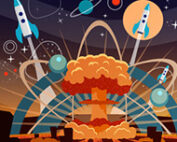
The screwdriver you start Criticality with is the only tool the game ever really trusts you to hold onto, and it’s genuinely all you need. Everything else — the reactor, the neutrons, the eventual chain reactions rattling across your screen — grows out of one click at a time, until “one click at a time” stops being an accurate description of what’s happening at all.
| Genre | Incremental, Clicker |
| Setting | Cold War |
| Platform | Windows |
| Mode | Single-player |
One Neutron, an Entire Reactor of Consequences
You start Criticality as an engineer alone at night with a shaky reactor and not much else, and the entire loop is built on a single physical idea stretched as far as it will go: a neutron hits an atom, the atom absorbs it and splits, and two more neutrons come out the other side. On its own that’s a small, quiet event. But those two neutrons can each hit another atom, and now you’re not managing one reaction, you’re managing a spreading one, and the game wants you to watch that spread happen in real time rather than abstract it into a number ticking upward.
Early sessions feel almost too calm for a game about nuclear chain reactions. A handful of atoms, a handful of neutrons, nothing that looks remotely dangerous yet.
That calm doesn’t last, and it’s not supposed to.
Upgrades That Change How the Reactor Behaves
Points earned from successful reactions get spent on upgrades, and this is where Criticality separates itself from a plain clicking exercise. The upgrades in the game generally fall into a few categories:
- Neutron output boosts, which increase how much each click actually contributes to a reaction
- Reactor capacity expansions, which let more atoms exist on screen at once before things get unmanageable
- New mechanics that unlock entirely different ways for reactions to cascade rather than just scaling the existing ones
Players who lean into optimizing a build tend to chase the mechanic-unlocking upgrades early, since they reshape the whole run rather than just making the existing loop bigger.
Chasing Critical Mass Without Triggering a Meltdown
The tension Criticality builds comes from a simple risk curve. Bigger reactions mean more points, but they also mean your reactor is closer to the kind of instability the game frames as a meltdown — the joke being that failure isn’t dramatized as catastrophe so much as an awkward conversation with your supervisor. That tonal choice matters. It keeps a game about atomic chain reactions from turning into something grim, and instead lets the tension stay purely mechanical: how far can you push this specific run before it collapses.
Newcomers to incremental games often push too aggressively too early, triggering avoidable instability before they’ve earned the upgrades that would let them recover from it.
What Prestige Actually Resets, and Why That’s the Point
Once your reactor hits a ceiling, Criticality offers a prestige option that resets your progress in exchange for permanent bonuses on your next run. This is standard territory for the incremental genre, but the game leans into it with its own rhythm:
- Push a single run as far as it can reasonably go before instability makes further gains inefficient
- Prestige, wiping your current reactor and points but keeping the multipliers you’ve unlocked
- Start the next run noticeably faster, since your baseline neutron output and capacity are permanently higher
Completionists chasing every unlockable mechanic tend to prestige more aggressively and earlier than players who just want to watch one enormous chain reaction play out uninterrupted.
The Cold War Joke Underneath the Chain Reactions
The Cold War framing gives Criticality a consistent voice instead of just a coat of paint. You’re not a generic scientist — you’re specifically an engineer working late, alone, with equipment that feels one bad click away from becoming a problem far bigger than a bad performance review. That specific voice is part of why the humor lands instead of feeling bolted on. The game commits to the joke rather than winking at it once and moving on.
Where the Community Actually Disagrees
Reception has been positive, but not without a recurring complaint: several players describe the early stretch of a fresh run, before enough upgrades kick in, as noticeably grindy compared to how fast things escalate later. It’s a fair criticism given how much of the game’s appeal depends on chain reactions actually cascading — a slow ramp-up works against the fantasy the second half of a run delivers so well.
Is Criticality difficult to learn for newcomers to incremental games?
No — the core loop of clicking to launch a neutron and watching atoms split is immediately understandable, and the game introduces new mechanics gradually enough that the added depth doesn’t overwhelm a first-time player.
What happens if your reactor hits meltdown in Criticality?
A meltdown effectively ends your current run’s momentum, undercutting the reaction you were building toward — the game frames it humorously as an awkward conversation with your supervisor rather than a hard game-over screen.
Does prestiging in Criticality reset all of your progress?
Prestiging resets your active reactor, points, and current atoms, but it permanently keeps the multipliers and unlocked mechanics you’ve earned, which is what makes each successive run start from a stronger baseline.
Criticality never stops being a game about one neutron hitting one atom — it just gets better and better at making you forget how small that first click actually was, right up until your reactor is putting on a show your supervisor would definitely have questions about.

 54
54
 1 Player




























 2684
2684


