
 For Boys
 For Girls
 For Kids
 Top Games
 My Games
 Top Games
 My Games


My Fire Is Bigger Than Yours Game Online
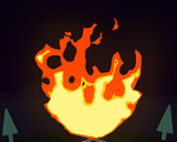
Description
You toss another handful of kindling onto the pile and watch the flames climb just high enough to survive the first drops hissing down from above. That tension between growth and collapse is the whole pitch of My Fire Is Bigger Than Yours, a physics-based incremental game where a single spark has to outgrow the Sun itself before the run ends.
| Genre | Incremental, Physics Simulation |
| Platforms | PC, browser demo |
| Structure | 3 escalating phases |
| Core Loop | Feed the fire, survive the Rain, unlock upgrades |
Feeding the Fire in My Fire Is Bigger Than Yours
The core mechanic sounds almost too simple: drag fuel toward the flame and watch it react. But My Fire Is Bigger Than Yours builds an entire economy around what you throw in and when. Wood catches slow and steady, fireworks detonate in chain reactions that can wipe out a weak fire in seconds, and lightning strikes add bursts of raw heat that reward players who like high-variance builds. Placement matters as much as timing, since Spawners can be dragged and re-angled to control exactly where fuel lands, and a Spawner aimed at the wrong angle can waste an entire stack of fuel by scattering it past the flame instead of into it.
Newcomers tend to dump everything near the center of the flame at once, which usually smothers it instead of growing it. The game rewards spacing fuel out so the fire can breathe and spread, rather than piling resources into one hot spot. Players who treat the early minutes like a puzzle, testing how each fuel type behaves before scaling up, tend to reach the later stages with far more control. Idle-focused players in particular learn to favor wood early on, since its slow, predictable burn gives Spawners time to settle into a rhythm without demanding constant clicking.
Once the Rain arrives, everything changes. This storm phase forces the fire to hold its size against a steady drain, and it’s the moment where sloppy early spending gets punished hardest. A fire that hasn’t stockpiled at least a small buffer of wood before the first drops fall will often shrink below the size it needs to keep progressing, forcing players to rebuild from a weaker position. Speedrunners have started timing exactly how long a given build can hold through the Rain before needing a second wave of fuel, and that number, sometimes referred to in community threads simply as “hold time,” has become a small bragging point in the community.
Explosion-heavy players chase a different kind of thrill here, deliberately stacking fireworks near the edge of the flame so a single detonation ripples outward and catches several other fuel piles at once. It’s a riskier approach than steady wood-feeding, since a badly timed chain reaction can just as easily blow a hole in the fire’s mass as grow it, but when it works it produces the fastest single-phase growth spikes in the entire run.
The Upgrade Tree and Build Variety
Beyond raw fuel, the upgrade tree is where My Fire Is Bigger Than Yours really opens up. Over 100 upgrades branch out from a central node system, and the tree visually shifts to highlight which upgrades are currently available, a small touch players mention often when talking about the game’s feel. Some upgrades push toward explosive chain-reaction builds, others toward slow, automated setups that barely need input once running. Each node typically demands resources earned from surviving a previous Rain cycle, which means the tree effectively gates how aggressively a player can specialize based on how well their earlier phases went.
- Chain-reaction builds that lean on fireworks for sudden bursts of growth reward players willing to accept occasional setbacks in exchange for the fastest possible scaling during a single Rain cycle.
- Automation-focused builds that use repositioned Spawners to feed the fire with minimal clicking suit players who prefer to set up a layout once and then watch the numbers climb, checking in only occasionally to adjust.
- Lightning-heavy builds favored by players who enjoy high risk for faster scaling trade consistency for burst potential, since a poorly timed strike can just as easily disrupt a fragile flame as feed it.
By the time a fire reaches the size needed to challenge the Sun, most runs have specialized into one of these directions rather than trying to do everything at once. Mixing all three approaches without committing tends to produce a fire that’s mediocre at surviving the Rain and mediocre at scaling quickly, which is why the community generally advises new players to pick a lane once the tree opens up enough options to allow it.
Automation nodes deserve a specific mention, since unlocking the mid-tier Spawner-control upgrades is often the point where the game shifts from active clicking to something closer to a management sim, and that shift in pacing is one of the more divisive design choices players discuss in reviews.
Facing the Sun
The final confrontation is less a boss fight and more a scale check. The Sun doesn’t attack directly; it simply represents the target size a fire must reach, and getting there means every earlier choice about fuel and upgrades compounds into one number. Players who ignored automation tend to hit a wall here, clicking frantically while their fire’s growth stalls out against a target that keeps demanding more mass than a manually-fed fire can realistically sustain.
One honest complaint that comes up in feedback threads is performance during heavy explosion chains, when firework fragments and lightning effects stack up on screen and the frame rate visibly drops, particularly on older laptops. It’s a known rough edge the developer has acknowledged addressing in patch notes, and it’s worth knowing about before diving into an explosion-heavy build on lower-end hardware, since a build that looks great on paper can become genuinely unplayable once dozens of firework fragments are rendering simultaneously.
By the time a fire reaches its second phase, most players have a clear read on whether their chosen build can realistically threaten the Sun, and that mid-run checkpoint has become an informal marker the community uses to judge whether a run is worth continuing or worth restarting with a different upgrade path.
What happens if my fire gets caught without fuel during the Rain?
If the fire runs dry mid-storm, it shrinks quickly and can drop below the threshold needed to keep progressing, forcing a restart of that phase. Keeping a small buffer of wood or fireworks in reserve before the Rain starts is the usual fix, and experienced players often stockpile enough fuel to survive at least one extended dry stretch before committing to an aggressive expansion.
Can I recover from a bad early build in My Fire Is Bigger Than Yours?
Early missteps aren’t usually fatal since the upgrade tree lets you pivot, but a fire built entirely around one fuel type will struggle to adapt once the Sun phase demands raw scale over cleverness. Players who diversify their upgrade choices during the first phase tend to have an easier time adjusting once the difficulty ramps up.
Is there a fastest way to grow the fire?
There’s no single fastest path, but players consistently report that automated Spawner layouts combined with a lightning-focused upgrade path produce the quickest climbs toward challenging the Sun, provided the player has already unlocked enough of the mid-tier tree to keep that lightning fed reliably.
What keeps players coming back to My Fire Is Bigger Than Yours isn’t the premise alone, it’s watching a build you tuned yourself survive the Rain and finally out-scale the Sun on a run where every Spawner placement actually mattered.

 126
126
 For Boys
  For Girls




























 2692
2692


