
 For Boys
 For Girls
 For Kids
 Top Games
 My Games
 Top Games
 My Games


Dirt Clicker Game Online
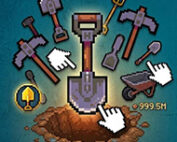
Description
Dirt Clicker looks like a cozy, half-hour distraction with a spoon icon and pastel dirt — but the moment your skill tree branches past the first layer, it plays like a genuine incremental with the same compulsive number-chasing pull as far denser games in the genre. What starts as an idle curiosity you check between other tasks slowly turns into a system you’re actively planning around, and that shift usually catches players off guard somewhere around the second layer.
| Genre | Incremental / idle digging game |
| Core Loop | Dig, sell treasures, hire workers, unlock deeper layers |
| Workers | Over 5 types, including Mushroom Buddies, Dirt Golems, and Druids |
| Collectibles | Over 40 diggable items plus hidden relics and badges |
You start with a spoon. That’s not a joke opener, it’s the literal first tool the game hands you, and every early click feels appropriately slow because of it. Progress in Dirt Clicker comes from that same simple gesture repeated until you can afford your first upgrade, at which point the game starts revealing how much systems are actually stacked underneath the cute presentation. Players coming from denser incrementals often underestimate the opening minutes, treating the spoon phase as filler rather than the tutorial it actually is for reading the game’s pacing.
Workers and the Early Skill Tree
Mushroom Buddies are the first hire most players unlock, and they’re the gentlest introduction to automation the game offers — slow, cheap, and forgiving if you mismanage your early currency. Dirt Golems come later and dig at a noticeably different rate, which is the point where idle-focused players start feeling the game reward patience over clicking speed. Druids round out the early roster with utility leaning toward the skill tree rather than raw output, and players optimizing for the fastest possible descent tend to prioritize Druids earlier than the game’s own tutorial hints suggest they should.
Skill tree points: earned through digging milestones rather than currency, the skill tree is the system that actually determines your long-term digging power, and ignoring it in favor of just buying more workers is the single most common beginner mistake in early sessions. New players tend to dump every spare resource into worker headcount, only to hit a wall once layer two demands digging power that raw worker count alone can’t provide.
Layer transitions are where the loop resets its pacing. Once you’ve cleared enough of a layer, you’re offered the choice to descend or keep excavating for leftover treasures, and the game doesn’t force the decision — players who want completionist runs stay behind to finish a layer, while players chasing raw progression descend the moment it’s viable. This is one of the clearer moments where different play styles diverge visibly: the completionist checking every corner of layer one before moving on, versus the progression-focused player who’s already three layers deeper by the time the completionist finishes their first sweep.
Treasures, Relics, and What Beginners Skip
Not every item you dig up is just a sell-for-currency object. Some are mysterious relics buried deeper in a layer, and these matter more than their sale price suggests since a handful feed directly into badge unlocks and late-game bonuses. New players routinely sell relics on sight without realizing what they’d lose, which is one of the more common regrets discussed once players get further into the digging empire — by the time someone reaches layer three or four and starts caring about badge completion, the relics they sold early for a handful of currency are often gone for good.
- Sell early treasures freely, since currency needs at the start comfortably outpace whatever collection value those first items would eventually have.
- Hold onto anything flagged with the distinct relic icon once you start noticing it, because relics feed directly into badge unlocks you can’t easily replace later.
- Check badge progress periodically rather than waiting until the very end of a run, since some badges track cumulative actions you might not realize you’re missing.
- Watch worker stats screens for anyone slacking before assuming your overall output has stalled, because a single idle Dirt Golem can quietly cap your digging rate for an entire session.
The game explicitly gives you a stats panel to catch underperforming workers, and it’s a detail easy to ignore until your digging speed plateaus for no obvious reason and you realize one Dirt Golem has been sitting idle the whole time. Community discussion around the stats panel is mixed — some players appreciate having the diagnostic tool at all, while others feel it should surface slacking workers more proactively instead of requiring a manual check.
Spells and the Layer Curve
By the time you reach the third or fourth layer, spells start entering the picture, and the game is upfront that some of them are powerful enough to meaningfully break your normal pacing. That’s clearly intentional design rather than an oversight, but it does mean two players at the same layer can have wildly different progression speeds depending on which spells they’ve found, which is a point of some friendly disagreement in the community about whether spell discovery should be more guided rather than left almost entirely to RNG.
Answering the question of what’s actually at the bottom is the game’s long-term hook. Dirt Clicker doesn’t reveal it early, and the badges and relics scattered through each layer function as breadcrumbs toward that answer rather than as pure collectibles. Players speculating in community threads about what the final layer holds have become something of a running tradition around the game, with theories updating each time a new relic type surfaces.
Whether you’re the type who watches automation numbers climb passively or someone actively hunting every relic before descending, Dirt Clicker’s layer structure gives both approaches a reason to keep digging rather than favoring one over the other. Even players who consider themselves burned out on the incremental genre in general tend to admit the layer-by-layer curiosity hook gets them further than they expected.
How do you know when a worker is slacking in Dirt Clicker?
The stats panel tracks individual output per worker, so a Mushroom Buddy or Dirt Golem producing noticeably less than its listed rate will show up there — it’s the fastest way to catch a stalled digging rate before it costs you significant time.
Should you sell or keep relics you find while digging?
Keep them. Relics feed into badge unlocks and late-game bonuses, and selling one for quick currency early on is the single most commonly regretted mistake new players report once they understand what badges actually require.
Is it better to fully clear a layer or descend as soon as possible?
It depends on your goal: descending quickly maximizes raw progression speed, while staying to clear a layer fully suits players chasing badges and relics, since leftover treasures and hidden pickups don’t carry forward once you move to the next layer.
Dirt Clicker earns its charm honestly — the spoon-to-empire arc is deliberately slow at first, but once Dirt Golems and Druids are working alongside you and the skill tree starts compounding, the game stops feeling like a five-minute clicker and starts feeling like the kind of incremental you check on between other tasks for days.

 163
163
 For Boys
  For Girls































 2696
2696


