
 For Boys
 For Girls
 For Kids
 Top Games
 My Games
 Top Games
 My Games


Scary Baldi Game Online
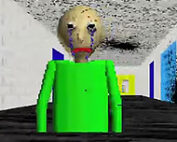
Description
You round a corner with a notebook tucked under your arm and hear the ruler-tap rhythm start up somewhere behind you, closer than it should be. Scary Baldi takes the familiar collect-and-flee loop of the schoolhouse and tightens it into something closer to straight horror game territory, where a single wrong answer can turn a quiet hallway into a dead end, and where the game seems to know exactly when you’ve stopped paying attention to your surroundings.
Collecting Notebooks Under Pressure in Scary Baldi
The core objective never changes across playthroughs: find seven notebooks scattered through the building, solve the arithmetic riddles inside each one, and get out before Baldi catches you. What changes in Scary Baldi is the pacing. Rooms feel tighter, hallways loop back on themselves more aggressively, and the game leans harder into jump-scare timing than the original loop ever did. Early on, players tend to treat notebook collection like a checklist, grabbing whichever one is closest without thinking about the layout they’re building in their head, which works fine for the first two or three notebooks but starts to fall apart once the schoolhouse stops feeling predictable.
That habit gets punished fast. By the time you’re holding your third or fourth notebook, Baldi’s patrol routes overlap more of the map, and backtracking to an unexplored room means crossing paths you’ve already made noise in. Players who slow down and mentally map the schoolhouse before grabbing notebooks tend to last longer than those who sprint for the nearest door, because Scary Baldi doesn’t reset Baldi’s awareness between rooms the way a more forgiving horror game might. Completionists chasing every hidden detail in a single run often pay for it with a much faster, angrier Baldi by the halfway point, since every extra minute spent exploring a side room is a minute Baldi’s patrol has to close the gap.
The riddles themselves stay simple by design — the horror isn’t in the math, it’s in what happens after you get one wrong. Community discussion around the game frequently points out that this is a deliberate choice rather than an oversight: the third question in each notebook beyond the first is intentionally unsolvable, which means the arithmetic was never really the obstacle. It’s a pacing device disguised as a puzzle, and once players clock that, their entire approach to the notebook run tends to shift from “answer correctly” to “answer quickly and get moving.”
First-time players sometimes assume they can clear a notebook fully before Baldi notices anything is wrong, but the game punishes that assumption almost immediately after the second notebook. Players who play cautiously — checking hallway sightlines before committing to a room — consistently report smoother runs than those who barrel through on instinct.
Baldi’s Chase Behavior and Sound Detection
Baldi doesn’t see you so much as hear you, and that distinction shapes how the entire game plays. Doors, running footsteps, and even bumping into furniture all register as noise, and each wrong answer in a notebook makes him faster and more willing to chase on a hunch rather than a confirmed sighting. Veteran players in the community call this the “notebook run” phase — the stretch after your second or third mistake where Baldi is close enough that every remaining notebook feels like a gamble, and where a single misjudged door slam can end the attempt outright.
New players consistently underestimate how much walking, rather than running, matters. Sprinting everywhere burns stamina and creates noise that draws Baldi toward rooms you haven’t even entered yet. The safer approach is deliberate movement punctuated by short bursts of speed only when you’re certain of your exit route. This becomes especially important once Baldi’s speed has ramped up past its early-game baseline, since at that point even a brief sprint in the wrong direction can put him directly in your path rather than behind you.
Sound detection in Scary Baldi isn’t purely binary — proximity matters as much as the noise itself. A door opened at the far end of the schoolhouse registers differently than one slammed two rooms away from Baldi’s current position, which means experienced players start tracking not just what noise they’re making but where Baldi likely is relative to it. This spatial awareness is the single biggest skill gap between players who finish their first run and players who get caught on notebook five or six.
Managing Bsoda, Chocolate Bars, and the Three Exits
Items scattered through the schoolhouse exist to buy you time, not to solve the chase outright. Bsoda knocks Baldi and other characters backward for a few seconds, giving you a window to slip past a blocked hallway rather than a permanent escape, and players quickly learn to save it for moments when Baldi is directly between them and an exit rather than using it reflexively the first time he appears. Chocolate bars restore stamina instantly, which matters more in the back half of a run when your sprint meter is the only thing between you and getting caught — burning through one too early, before the chase phase really begins, is a common mistake among players still learning the game’s rhythm. Scissors, when found, temporarily clear certain obstacles out of your path, and a teleporter can reposition you randomly across the map — useful when cornered, risky when you don’t know what’s on the other side, since it can just as easily drop you closer to Baldi as away from him.
Scary Baldi keeps the original’s rule about exits: there are three, but only one is real, and all three must be activated before the true exit becomes usable. This is where the game creates its most divisive moment for players. Some find the ambiguity tense and rewarding once they’ve mapped which exit responds correctly; others find it frustrating on a first run, since there’s no reliable way to know which exit works without triggering all of them first, and that uncertainty forces a full lap of the schoolhouse right when Baldi is at his most dangerous.
Item management becomes a genuine resource-planning problem by the late game, not just a reflex test. Players who hoard a single Bsoda for the final exit push, rather than spending items as soon as they’re found, tend to survive the last stretch far more reliably than those who treat every pickup as an immediate-use tool.
- Bsoda knocks Baldi and other pursuing characters backward for a few seconds, which is enough to slip past a blocked doorway but not enough to lose him entirely if you hesitate afterward.
- Chocolate bars restore stamina instantly, and saving one for the final exit push rather than using it early often decides whether a run succeeds.
- Scissors temporarily clear specific obstacles, which matters most when a shortcut route would otherwise force a longer, noisier detour past Baldi’s patrol.
- The teleporter repositions you randomly across the schoolhouse, a useful emergency tool when cornered but a genuine risk since it can land you closer to danger just as easily as farther from it.
Where New Players Struggle in Scary Baldi
First-time horror players often go in expecting a slow burn and get caught off guard by how quickly the tension escalates once the second notebook’s questions turn unsolvable. That’s intentional — the impossible third question in each book after the first is the game’s way of guaranteeing Baldi eventually notices you, no matter how careful you’ve been. Players who treat the early notebooks as a grace period, using that time to memorize room layouts instead of rushing, tend to handle the later chase phases with far less panic, since they already know which hallways lead to dead ends before Baldi is actively hunting them.
Speedrun-minded players approach Scary Baldi differently, favoring routes that grab notebooks in a specific order to minimize backtracking, even if it means answering a question wrong on purpose to save time elsewhere. It’s a legitimate strategy, but one that only works once you already know the schoolhouse by heart, since guessing wrong on an unfamiliar layout tends to strand a player exactly where Baldi’s patrol is heaviest.
Players jumping in expecting a slower, more forgiving horror game are often the ones who struggle most in the first few attempts, since Scary Baldi doesn’t ease players into its escalation the way some horror titles do. The learning curve is steep specifically because the punishment for a mistake compounds — a wrong answer doesn’t just cost you a moment, it permanently raises the baseline threat level for the rest of that run.
What happens if you answer every question wrong in Scary Baldi?
Answering incorrectly across the board leads to an alternate ending rather than a game over on its own, giving players who intentionally fail every unsolvable third question a distinct narrative payoff for that approach. It does, however, speed up Baldi’s pursuit dramatically with each wrong answer, so most players who go this route are already prioritizing a fast, chaotic run over a careful one and accept that the schoolhouse will feel considerably more hostile by the final notebook.
How many notebooks do you need to collect to finish Scary Baldi?
All seven notebooks are required before any of the three exits can be triggered. Skipping one isn’t an option — the game tracks your progress internally and won’t let the true exit activate until every notebook has been resolved, which means there’s no shortcut around a full sweep of the schoolhouse no matter how efficient your route.
Why does Baldi get faster the longer you play?
Every wrong answer and every notebook collected pushes Baldi’s speed up incrementally, stacking across the whole run rather than resetting between rooms. It’s a deliberate escalation curve rather than a bug, designed to make the final stretch of notebooks — and the scramble to find the real exit among the three available — feel meaningfully more dangerous than the opening minutes ever do.
Whether you’re mapping the schoolhouse on a first blind run or chasing a faster exit route on a repeat attempt, Scary Baldi keeps its tension rooted in that one unstable variable: Baldi’s hearing. Every Bsoda you save, every wrong answer you risk, and every one of the three exits you test all come back to the same question the game keeps asking — how much noise are you willing to make to get out with all seven notebooks in hand.

 46
46
 For Boys
  For Girls




























 2697
2697


