
 For Boys
 For Girls
 For Kids
 Top Games
 My Games
 Top Games
 My Games


A Game About Breaking A Cube Game Online
Description
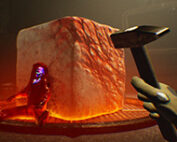
In A Game About Breaking A Cube you start with a hammer and a quota, which matters because both of those things are smaller than you expect them to be. You are E.R.A.S.E.R., an operative hired by NullCorp to descend into the company’s underground facility and break cubes for reasons the company describes as productive and refuses to elaborate on. The first cube you crack open is stone. The second is metal. By the time you reach cubes made of meat, you have probably already noticed that NullCorp’s paperwork does not mention meat.
| Genre | Horror Simulation / Indie Adventure |
| Platform | Windows |
| Player Role | E.R.A.S.E.R. operative |
| Employer | NullCorp |
| Core Tool | Hammer (upgradeable) |
| Demo Length | 20–30 minutes |
The Breaking Loop and What A Game About Breaking A Cube Actually Asks You to Do
The central loop of A Game About Breaking A Cube is simpler than most games of its type: go down to the facility, break assigned cubes with your hammer, extract the ore or material inside, burn the contaminated pieces that cannot be kept, and return to the surface. NullCorp calls this Project ERASURE. The game does not explain what ERASURE stands for, and it does not need to — the name does enough atmospheric work on its own once you start pulling teeth and unidentified flesh out of cubes that were previously indistinguishable from ordinary stone boxes.
The hammer upgrade system is the game’s primary mechanical progression. Early cubes yield simple ore and respond to basic hammer strikes without requiring precision. As A Game About Breaking A Cube advances you through the facility, cube materials escalate in density and resistance, and the base hammer becomes visibly insufficient. Upgrades are purchased between shifts, meaning you surface from the facility, assess what you found, spend the ore value on hammer improvements, and go back down. The loop has a satisfying cadence once you internalize it — surface, upgrade, descend, break something weird.
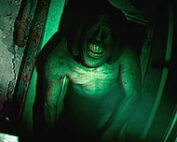
What the loop quietly introduces, and what players consistently describe as the moment the game shifts tones, is the point where the extracted contents stop being identifiable as mining resources. Teeth appear. Then flesh. Then artifacts that do not have category labels in the inventory UI because NullCorp presumably did not include them in your intake briefing. A Game About Breaking A Cube does not announce this transition with a cutscene or a dramatic audio cue. The first time you crack a cube and find something biological, the shift is understated enough that you might complete the shift before fully registering what you just harvested.
Exploring the NullCorp Facility Beyond Your Assigned Cubes
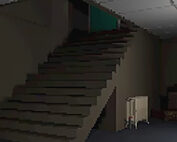
The underground facility in A Game About Breaking A Cube is larger than your daily quota requires you to explore. Red tape — literal and figurative — cordons off restricted sections, and A Game About Breaking A Cube makes it clear that crossing into those areas is not authorized by your NullCorp contract. It is equally clear that the answers to what Project ERASURE actually is live behind that red tape, and that no one is going to give you answers by staying on the approved path.
Players who confine themselves to breaking assigned cubes and returning to the surface will complete the game with a functional understanding of the loop and a very incomplete picture of the story. The multiple endings in A Game About Breaking A Cube are gated behind willingness to investigate, to cross NullCorp’s designated boundaries, and to keep breaking things even when what comes out of the cube is something you did not expect to see during what was described as a routine extraction shift.
The facility’s maze-like underground layout rewards players who mentally map corridors as they work. Early in the game, your hammer quota and upgrade level limit how deep into the facility you can practically operate before needing to surface. By the time you have upgraded the hammer significantly, whole sections of the underground that previously required too many strikes per cube become accessible at a reasonable time cost. The space that felt small in the first shift expands considerably once your tools can handle what lives down there.
Drinkable Meat and the Tone of A Game About Breaking A Cube
Between shifts, E.R.A.S.E.R. returns to a surface living area, and the game offers you a cold can of drinkable meat to relax with. This detail — mentioned in the game’s own description with complete sincerity — tells you more about the tone of A Game About Breaking A Cube than almost any other single element. The game is not a pure horror experience and it is not a pure comedy experience. It is a corporate dystopia played entirely straight, where the horror and the absurdity occupy the same space without either undermining the other.
This tonal balance is something the community discusses with genuine appreciation, but it is also a point of contention. Players who came to A Game About Breaking A Cube expecting a traditional horror game, based on the flesh-and-teeth cube contents and the nihilistic themes listed in the game’s content warnings, sometimes find the drinkable meat aesthetic deflating. The wrongness of what NullCorp is doing does not hit harder because of the corporate banality around it — it hits differently, and not every player wants that particular register.
Players who came for the dark humor and the indie-weird atmosphere tend to find A Game About Breaking A Cube remarkably well-calibrated for what it is trying to do. The can of drinkable meat is not a joke that breaks tension; it is part of the world, and the world is coherent on its own terms. Whether you find that coherence satisfying or slightly frustrating probably depends on how you personally want your horror served.
What Beginners Miss in A Game About Breaking A Cube
The most consistent beginner mistake in A Game About Breaking A Cube is burning everything that looks unusual. NullCorp provides contaminated items for burning, and the burn mechanic exists for a reason — but players who aggressively torch any cube content that deviates from clean ore are destroying materials that later upgrade tiers and exploration routes require. Learning to identify what NullCorp classifies as contaminated versus what is simply unusual is part of the game’s skill curve.
Upgrade sequencing is the other major area where new players lose efficiency. The hammer has multiple upgrade paths, and putting early ore into surface-level improvements delays access to the deeper facility by several shifts. Players who prioritize the upgrades that directly affect cube resistance — rather than those that affect peripheral features — reach the meat cubes and the biological anomalies earlier, which also means earlier access to the story content that lives behind NullCorp’s red tape.
Exploration timing is the third overlooked element. Players who try to investigate every restricted section of the facility in the first two shifts consistently run out of hammer durability or shift time in areas that require sustained breaking capacity to traverse. Early in the game, note the locations of red tape sections and return to them after two or three upgrade cycles. The facility is not going anywhere, and NullCorp’s secrets are patient.
Common Questions About A Game About Breaking A Cube
What are the multiple endings in A Game About Breaking A Cube?
The endings in A Game About Breaking A Cube are tied to how deeply you investigate NullCorp’s restricted facility sections and what you do with the artifacts you recover from biological cubes. Staying within your assigned quota and following NullCorp’s approved route leads to one outcome; crossing the red tape boundaries and pressing into the deeper underground spaces reveals what Project ERASURE actually entails and opens alternate conclusions. Specific ending conditions involve choices made during restricted-area exploration rather than during standard cube-breaking shifts.
How long does A Game About Breaking A Cube take to complete?
The demo covers roughly one full in-game day and runs 20 to 30 minutes. The full game structures progression across multiple shifts and is longer than the demo suggests once you factor in upgrade cycles, restricted-area investigation, and the time required to process what the meat and artifact cubes contain. Players focused entirely on the main quota loop and who minimize exploration will complete it faster; players who dig into every corner of the NullCorp facility and pursue all endings will extend their time considerably.
Does the hammer upgrades affect what you find inside cubes in A Game About Breaking A Cube?
The hammer upgrades affect which cubes you can practically break within a shift’s time constraints rather than changing what is inside any specific cube. Higher-tier hammers break dense material cubes — the metal types and later the biological anomaly cubes — without the excessive strike count that lower-tier tools require. What you find inside a given cube is fixed; what changes is whether your current hammer makes accessing that cube a reasonable use of a shift or an inefficient grind that costs you upgrade ore you needed for something else.
A Game About Breaking A Cube earns its staying power from the gap between what NullCorp tells E.R.A.S.E.R. the job is and what the facility actually contains. The hammer loop is satisfying on its own terms, but the moment teeth appear in what was supposed to be a standard ore cube is when the game stops being a curiosity and becomes something players want to dig deeper into — which is exactly what Project ERASURE is counting on.

 45
45





























 2697
2697


